Shwedagon Pagoda
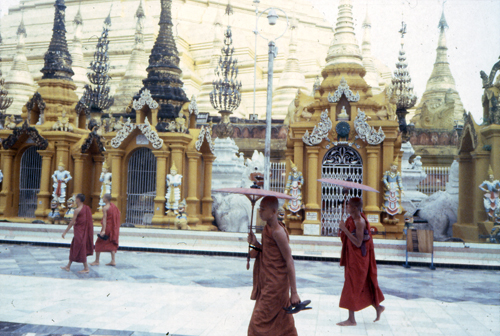
The Shwedagon Pagoda is a massive golden stupa, in Yangon (Rangoon), Myanmar (Burma). (Darn this endless double-naming!) According to Wikipedia, “The crown or umbrella is tipped with 5, 448 diamonds and 2,317 rubies. The very top, the diamond bud, is tipped with a 76 carat (15g) diamond.” In the background of this picture you can see the base of the stupa, and surrounding it is an enormous complex that buzzed with the activity of monks, worshippes and tourists and reminded me of (no disrepect to this sacred site intended) the North Carolina State Fair.
Bagan
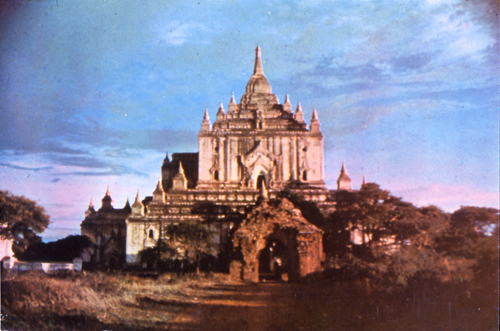
At the airport as I was leaving Burma, I spent my last few kyats (“chats”) on a souvenir picture postcard of one of the thousands of temples in Bagan, which I had visited just a few days earlier. The color does not seem oversaturated to me. It strkes me as just right. Perfect. Bagan (“Pah-garn”) is an amazing place.
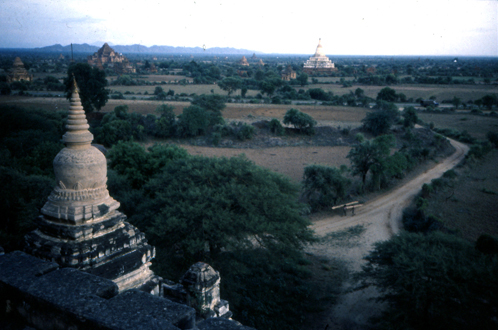
At one time there were over 13,000 temples on this plain in central Burma, on the east bank of the wide and muddy Irrawady (properly the Ayeyarwady) River. About 2,200 of these temples remain standing today. It is not until you climb to the top of one of them that the rest of them are revealed. They dot the landscape like jewels. Really, that’s how it feels!
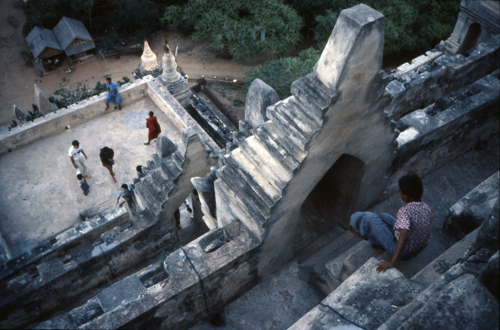
Climbing the temple. Up here some boys tried to sell me some stones, which they said were jewels, rubies I think. The scraped them and showed that they didn’t scratch. They said they would take anything for them, but I (foolishly) wasn’t interested.
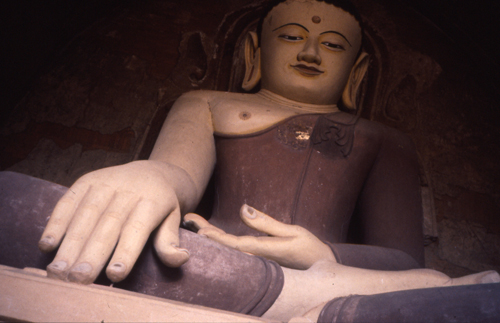
A massive Buddha in the base of one of the temples. You had to wander about, into the shadows, to find the doorways and stairways to the next level. There was a feeling of real adventure about this place. Like Indiana Jones, but that was just a movie!
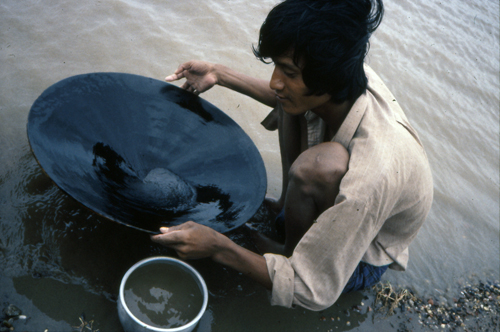
Panning for gold by the Irrawaddy river.
The world’s largest book
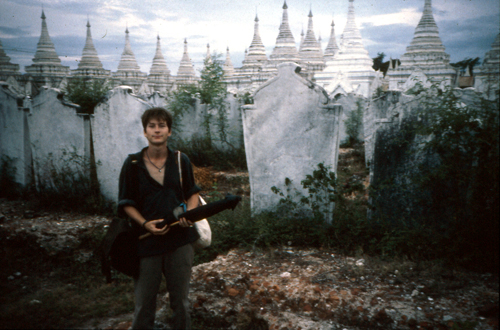
The world’s largest book stands at the foot of Mandalay Hill in Mandalay, Burma. The text is carved and inscribed in gold, in the Burmese abugida script, into both sides of 730 stone tablets, for a total of 1460 “pages.” Each stone tablet stands under a white structure with its own roof with a precious gem on top, and these structures are arranged around a larger golden pagoda. The carefully edited text is the Tipitaka Pali canon of Theravada Buddhism. Construction on this enormous project began in 1860 and was completed in 1868. I visited it in 1986. It was a grey day and as I recall was no one at all on the grounds, tourist or local, as a friend and I explored it. It was run-down, but there were signs that someone was caring for it as best they could. As a graphic designer and a book lover I was impressed but saddened. It is an amazing structure, an astonishing thing, really, standing neglected in a dusty corner of the world.
Click here for more pictures and information from Wikipedia.
The Burmese abugida
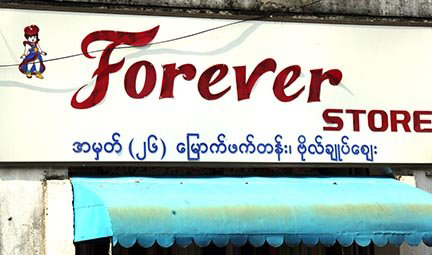
By way of the Digital Traveler, here’s a picture of a storefront in Rangoon, Myanmar. The name Myanmar suggests that the picture was taken after June 18, 1989, when the ruling junta changed the name of the country from Burma to Myanmar. The striking circular letterforms are Burmese characters. (Let’s hope they will never be designated “Myanmarian.”)
Here’s what I just learned about the Burmese alphabet at Wikipedia:
It is properly called the Burmese abugida, and the characters are round because straight lines would have ripped the palm leaves on which it was traditionally written. There are 33 consonants, but the last letter in this alphabet—although recognized as a consonant, is actually a vowel,—and this secret vowel can furthermore be used to indicate other vowels.
This alphabet reads from left to right, just as English does. There are no spaces between words, but when casually written there are sometimes spaces between phrases. The puctuation is limited to two characters, one or two downward strokes, which serve as a comma and a period, respectively. (This is perhaps not so strange when you consider that in Roman times, Latin was written without worspaces and without punctuation of any kind.)
The Burmese abugida evolved from the Mon script, which has its roots in the Brahmi script of ancient India, which many academics now believe “had indigenous origins, probably from the Indus Valley (Harrapan) script.” Which is a way of saying that it probably does not share a common ancestor of European scripts, as had long been believed.
sterling insignificance
“He was giving orders for a toothpick-case for himself, and till its size, shape, and ornaments were determined, all of which, after examining and debating for a quarter of an hour over every toothpick-case in the shop, were finally arranged by his own inventive fancy, he had no leisure to bestow any other attention on the two ladies, than what was comprised in three or four very broad stares; a kind of notice which served to imprint on Elinor the remembrance of a person and face, of strong, natural, sterling insignificance, though adorned in the first style of fashion.”
—Jane Austen, Sense and Sensibility, 1811.
the people of Burma
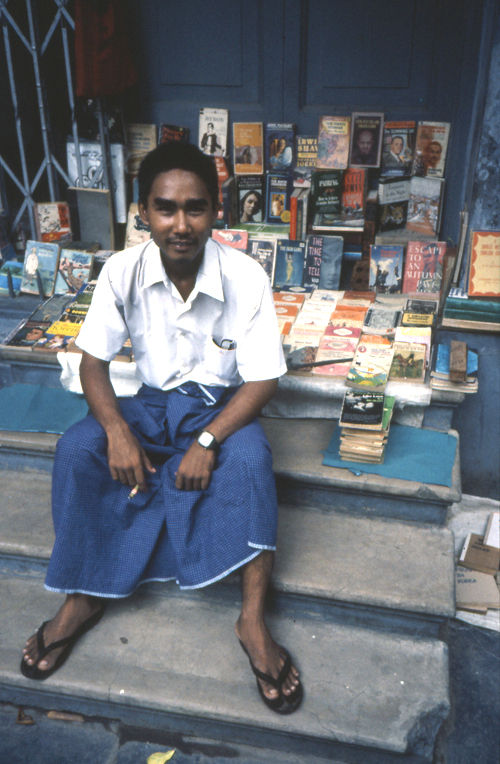
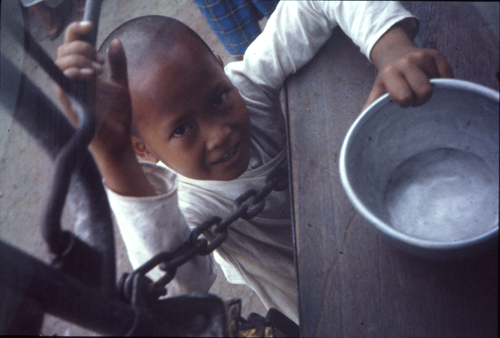
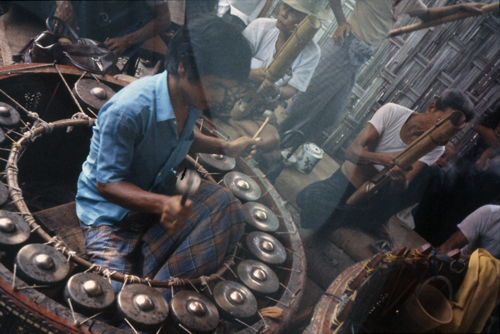
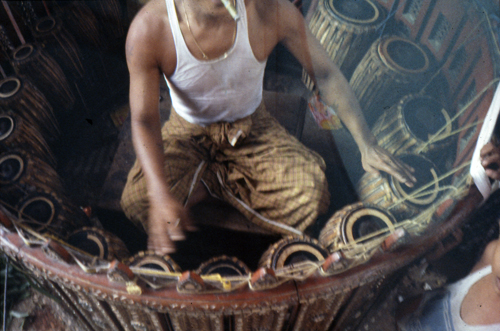
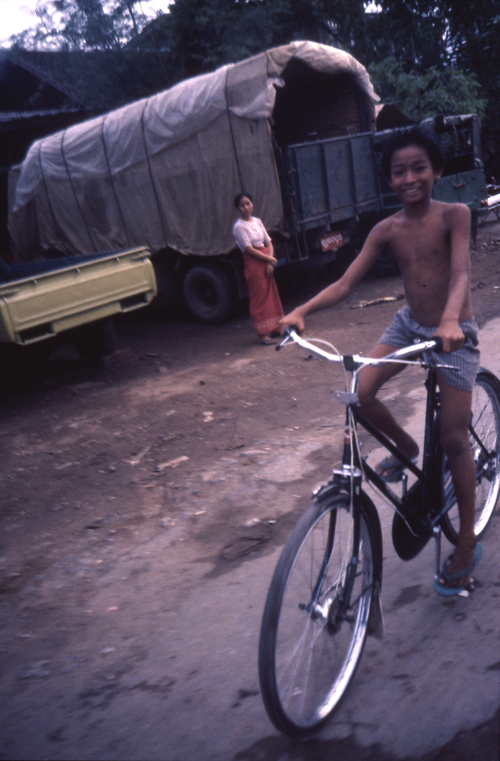
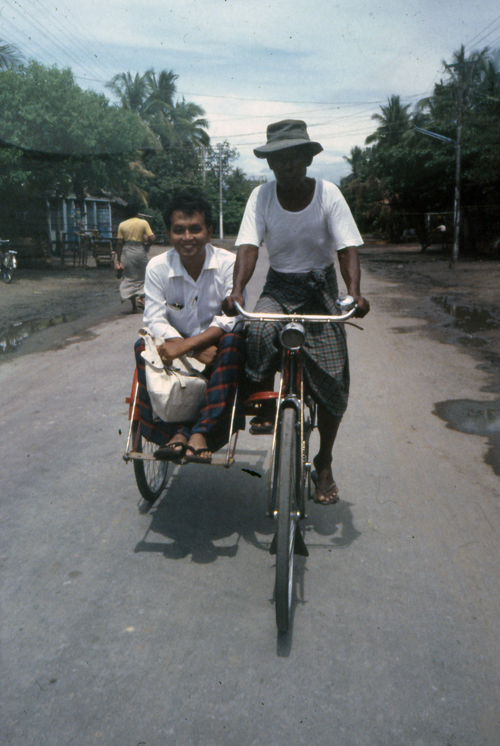
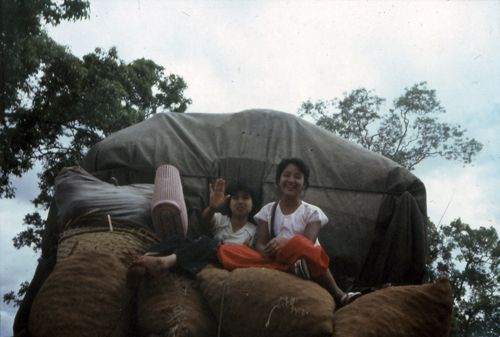
In 1986 I was admitted to the country of Burma with a one-week tourist visa. I quickly teamed up with three other travellers, and we enjoyed an astonishing whirlwind week. This was way back when Burma was called Burma by everyone, before thousands of marchers for democracy were killed in the streets in 1988. This was before tourist restrictions on photography so I was lucky to be allowed to take them freely.
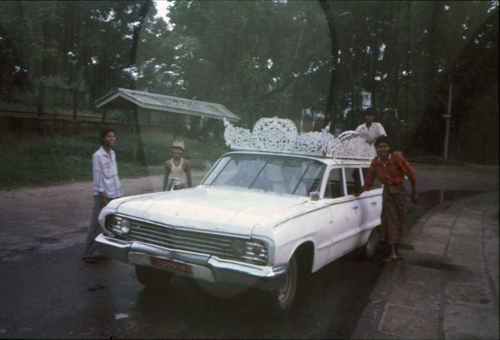
There were very few cars in Burma, and these were all decades old and therefore delightful to the tourist. I also liked the ornamental luggage rack on this one. After taking the picture, I helped these guys push-start it.
Free Burma
lost and forgotten, like sunsets vanished
“He had expected somehow that Washington would be a scene of great international excitement with diplomats, ambassadors, foreign generals rushing by with eager entourages towards some indistinct place in the city blazing with light, all a-murmur with rumors, great preparations, mighty pronouncements. But it was just a lot of soldiers and sailors and Marines passing in the dusk, and sad girls strolling, and birds singing in the park, and trolleys clanging mournfully across the lowering darkness, and the lights coming on. Something was lost and forgotten, like sunsets vanished, and old names and dust, and the remembrance of history books, Civil War songs, and brown daguerreotype portraits of dead families.”
—Jack Kerouac, The Town and the City, 1950.
the letter Q

Thanks to the rebranding of QVS, the cable shopping channel that no one has ever admitted to watching, let alone using, the letter Q is in the news! Here are a few things I learned this week:
“‘Q’ might be a rare letter in the English language (and even rarer in most Germanic languages), but its unusual nature makes it popular with marketers.
The US trademark database reveals 1,971 records with the letter ‘Q’ on its own, in every conceivable category, from clothing and consumer goods to piezoelectric crystals to food products.”
—NameWire, “the product naming blog.”
“In fact, there are 603 US trademarks either pending or already registered for products and services named ‘Q,’ without any embellishment.
And in the past few years, ‘Q’ has actually become a popular substitute for ‘K.’ This is partly to make names seem more hip and partly to make them easier to trademark.”
—NameWire, “the product naming blog.”“Q is a sexy, cool letter. It’s much better than an L or an A, which are tough to brand.”
—Jeff Charney, chief marketing officer for QVC, at Advertising Age.
“We’d really like to own the 17th letter of the alphabet.”
—Jeff Charney, chief marketing officer for QVC, at The New York Times.
Is this what it has come to? Am I the only one disturbed by this? We can’t let them take, uh . . . any more of OUR letters!
so far gone!
“And then they lay back with their arms as pillows and looked up at the milky stars and talked.
‘You look at those things long enough and you’re knocked out,’ said Buddy, staring astonishedly at the stars. ‘They’re so far off, you know’’
‘What do you expect!’
‘I mean they’re so far, so far gone! Deep! You look up there long enough and it’s just like looking into a big hole, you’re afraid you’ll fall in it—like when you drink too much.’”
—Jack Kerouac, The Town and the City, 1950.