the Roman
“The Greek alphabet, derived from the Phoenician, gave rise to the Etruscan, which in turn gave rise to the Roman, in use among western nations today.”
—Mario Pei, The Story of Language, 1965.
the Cyrillic
“[A] version of the Greek alphabet was devised by two bishops from Constantinople, Cyril and Methodius, for the Slavs to whom they brought Christianity in the ninth century. Faced with Slavic sounds which did not exist in Greek, they stretched the Greek alphabet as far as it would go, then drafted one or two Hebrew characters and invented others. The result was the Cyrillic alphabet used today by those nations which followed the Eatern Church—Russians, Ukranians, Serbs, and Bulgars.”
—Mario Pei, The Story of Language, 1965.
Black Letter
“[T]he German Gothic or Black Letter alphabet, first developed around the twelfth century from the earlier Carolingian script used by scribes at the court of Charlemagne and his successors. Black Letter was used in English till the sixteenth century, when it was replaced by the plainer Roman.”
—Mario Pei, The Story of Language, 1965.
The colours of life
“‘The colours of life in youth and age appear different, as the face of nature in spring and winter.’”
—Samuel Johnson, Rasselas, 1759.
make your choice, and be content
“‘Of the blessings set before you make your choice, and be content. No man can taste the fruits of autumn while he is delighting his scent with the flowers of the spring: no man can, at the same time, fill his cup from the source and from the mouth of the Nile.’”
—Samuel Johnson, Rasselas, 1759.
the colours of paradise
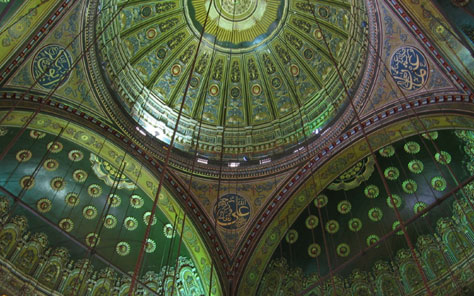
“Revered is the colour green, which has been associated with Islam as a symbol of the religion itself. Green is the sacred colour of Islam, and is used for the bindings of the Qur’an (the Muslim Holy Book) and in the silken covers of the Sufi saints. It has been suggested that green is revered because it was worn by Muhammad, but it also symbolizes life and nature. When finally reaching paradise in the afterlife, the Qur’an states, ‘ornaments shall be given to them therein of bracelets of gold, and they shall wear green robes of fine silk and thick silk brocade interwoven with gold, (18:31)’ and they will be ‘Reclining on green cushions and beautiful carpets (55:76).’ In Islamic culture green and gold are the colours of paradise.”
—Colors of Religion: Islam, an article at COLOURlovers.com. And COLOURlovers is only one of our new links. Check ’em out, they are all YOURS TO ENJOY!
what is commonly thought small
“Let us not take it for granted that life exists more fully in what is commonly thought big than in what is commonly thought small.”
—Virgina Woolf, quoted in Schott’s Original Miscellany, 2003.
resolved to be a poet
“‘Being now resolved to be a poet, I saw every thing with a new purpose; my sphere of attention was suddenly magnified: no kind of knowledge was to be overlooked. I ranged mountains and deserts for images and resemblances, and pictured upon my mind every tree of the forest and flower of the valley. I observed with equal care the crags of the rock and the pinnacles of the palace. Sometimes I wandered along the mazes of the rivulet, and sometimes watched the changes of the summer clouds. To a poet nothing can be uselsess.’”
—Samuel Johnson, Rasselas, 1759.
The sun
“The sun is God.”
—J.M.W. Turner, the British landscape painter. His last words.
the power of lights
“Again to my great surprise there were “all-coloured lights” which lighted and shone as diamonds on to every part of this house, even I tried my best to find out from where the lights were coming, but it was in vain, because it was not quenched both day and night. As it surprised me greatly I asked her about it, she replied,‘the power of lights is among my supernatural powers.’”
—Amos Tutuola, My Life in the Bush of Ghosts, 1954.
Yes, this is the book (or at least the title) that inspired one of the most influential record albums of 1980 (or at least its title), David Byrne and Brian Eno’s My Life in the Bush of Ghosts. The broken english is all sic and stet . . . it’s just as Amos Tutuola wrote it.