longer and wider seals
“The short and narrow cylinder-seals . . . bearing monotonous friezes of schematized animals or geometric designs . . . were [later] replaced . . . by longer and wider seals with totally different compositions depicting either ‘banquet scenes’ or ‘animal-contest scenes’. . . . There were also some religious motifs, such as the sun-god on a boat. . . . Some seals, notably those of kings, were made of lapis-lazuli or other semi-precious stones, or even of gold, and they were sometimes capped with silver at both ends. An important novelty was the appearance . . . of the first short cuneiform inscriptions on cylinder-seals.”
—Georges Roux, Ancient Iraq, third edition, 1992.
‘cuneiform’ writing
“The writing used in Mesopotamia throughout history and known as ‘cuneiform’ was originally—as all primitive writings, past or present—a collection of small, simplified drawings, or pictograms. . . . [I]n all probability the first pictograms were engraved on wood or painted on skins or leaves, but such media must have disintegrated long ago in the humid subsoil of Iraq, and the only documents that have survived are written on clay. The process of writing was in itself very simple: the scribe took a lump of fine, well-washed clay and shaped it as a small, smooth cushion, a few centimetres square. Then, with the end of a reed stalk cut obliquely he drew lines dividing each face of the cushion into squares and filled each square with incised drawings. The ‘tablet’ was then either baked or left unbaked. Baked tablets are nearly as hard a stone; old unbaked tablets crumble into dust between the fingers, but if they are collected with care, allowed to dry slowly in the shade and hardened in an oven they become almost indestructible. It must be added . . . that a number of archaic inscriptions were engraved in stone, at first with a bronze point, then with a cold chisel.
In the course of time the Mesopotamian script gradually lost its pictographic character. The signs were laid down in horizontal lines rather than in squares or in vertical bands. They became smaller, more compact, more rigid, more ‘abstract’, finally bearing no resemblance to the objects they represented. The awkward curves disappeared and were replaced by straight lines, at first, of equal width, then—as the prismatic stylus was forced into the clay proir to being drawn on its surface—vaguely triangular or wedge-shaped. Towards the middle of the third millennium B.C. this evolution was completed and the true ‘cuneiform’ writing (from Latin cuneus: wedge, nail) was born. . . .”
—Georges Roux, Ancient Iraq, third edition, 1992.
writing boards
“Sometimes the scribe did not impress his style into clay but into wax spread over ivory or wooden boards, several boards being bound together by means of metal hinges like a miniature folding screen. In 1953 a number of such writing boards, some of them still bearing traces of an astronomical composition, were discovered at Nimrud in a well where they had been thrown during the sack of the city.”
—Georges Roux, Ancient Iraq, third edition, 1992.
a halo of dazzling light
“[The Sumerian] gods, like the Greek gods, had the appearances, qualities, defects and passions of human beings, but they were endowed with fabulous strength, supernatural powers and immortality. Moreover, they manifested themselves in a halo of dazzling light, a “splendour” which filled man with fear and respect and gave him the indescribable feeling of contact with the divine, which is the essence of all religions.”
—Georges Roux, Ancient Iraq, third edition, 1992.
‘to build high’
“[T]he word ziqqurat (sometimes transcribed ziggurat or zikkurat) comes from a verb zaquru, which simply means ‘to build high’. . . . All considered, perhaps the best definition of the ziqqurat is given by the Bible (Genesis xi. 4), where it is said that the ‘Tower of Babel’ (i.e. the ziqqurat of Babylon) was meant ‘to reach unto heaven’. In the deeply religious mind of the Sumerians these enormous, yet curiously light constructions were ‘prayers of bricks’ as our Gothic cathedrals are ‘prayers of stone.’ They extended to the gods a permanent invitation to descend on earth at the same time as they expressed one of man’s most remarkable efforts to rise above his miserable condition and to establish closer contacts with the divinity.”
—Georges Roux, Ancient Iraq, third edition, 1992.
the true ‘Mesopotamian heritage’
“In approximately 3300 B.C., about two centuries before the Egyptians, the Sumerians invented writing, [a] fundamental revolution which enabled man to communicate with distant other men; to refine and develop his thoughts; to transmit them from one generation to the other, making them immortal since they were engraved on stones and, more often, on clay, both imperishable materials. Together with the Mesopotamian Semites (Akkadians, Babylonians and Assyrians), the Sumerians used this wonderful tool not only for their accounts, but also to retain memories of the past; to assemble in a coherent system a number of hitherto disparate religious concepts; to honour and serve their gods and obtain from them a glimpse of their own future; to glorify their kings; to codify their laws; to classify the fascinating world around them and lay the foundations for scientific research; to use myths, legend, epic tales and ‘counsels of wisdom’ in order to express their properly philosophical ideas, ranging from the creation of the cosmos and man to the insoluble problem of Good and Evil; and for thousands of other things which cannot be listed here, for no other peoples in pre-classical antiquity has left us so many texts of all kinds. This is the true ”Mesopotamian heritage”. . . .”
—Georges Roux, Ancient Iraq, third edition, 1992.
Fireworks
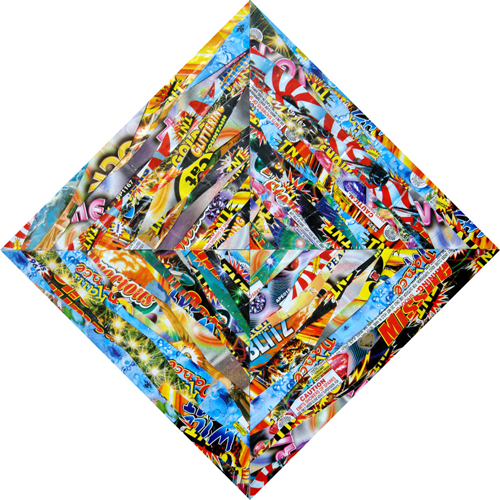
Fireworks, a collage by Paul Dean, 17″x17″, 2007. A present for George and Gail, it includes fireworks packaging from their wedding celebration.
a beautiful dull sheen
“‘But that day I’d seen this iron thing, a little brooch with a beautiful dull sheen, to be worn around the neck, you know how nice that would look on my breast.’—‘On your brown breastbone a dull gold beautiful it would be baby, go on with your amazing story.’”
—Jack Kerouac, The Subterraneans, 1958.
the sea of blackness
“Bear with me all lover readers who’ve suffered pangs, bear with me men who understand that the sea of blackness in a darkeyed woman’s eyes is the lonely sea itself and would you go ask the sea to explain itself. . . ?”
—Jack Kerouac, The Subterraneans, 1958.
the crystal chandelier of eternity
“. . . all thoughts meet in the crystal chandelier of eternity. . . .”
—Jack Kerouac, The Subterraneans, 1958.