This purple knows about this pink
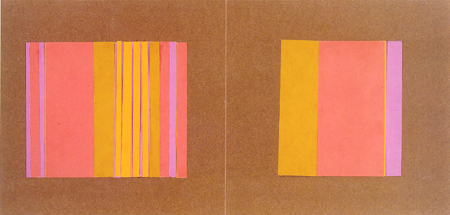
“[Josef] Albers’s remarkable ability to use words to prize the character of color was a vital component of [his color] course. . . . ‘This one smells like Cuban cigars,’ he might say, or ‘it tastes like a roast beef dinner with a nice Burgundy.’ A brown, lacy study had ‘a grandmother quality.’ Albers praised one study in stripes [pictured above], saying it was like ‘good aged mellow cheese.’
Along with this, Albers would concoct little melodramas to help his students see the color performances: ‘Look here! This green is creeping in. It’s a monster coming in from the edge and taking over. . . .’ Or ‘This purple knows about this pink. You see, it’s happy to be next to it, and it keeps it from running away.‘ A certain red ’wants to take control, to be a fascist.’. . . One student recalls a conversation between yellow and orange: . . .
“Look! The color orange is at the door and says to the yellow, ‘You go first.’ But the yellow is also polite and says, ‘No, you go first.’ They are like good friends, and their conversation is very charming.’”
—Frederick A. Horowitz, from Josef Albers: To Open Eyes, by Frederick A. Horowitz and Brenda Danilowitz, 2006.
Wish I was an English muffin
“Wish I was an English muffin
’Bout to make the most out of a toaster.
I’d ease myself down,
Comin’ up brown.”
—Punky’s Dilemma, words and music by Paul Simon, from the Simon & Garfunkel album Bookends, 1968.
Chinese paper
“The invention of paper is usually ascribed to Ts’ai Lun . . . a prominent official under Ho Ti (A.D. 89-106). . . . He is said to have made paper out of tree bark, hemp, or fish nets. . . . The oldest examples of Chinese paper known to us today . . . show that at a very early date paper was being made that was thin, white, and of good quality. Since then, paper has been made from bamboo, mulberry, hemp, corn and rice stalks, cotton, flax, silk cocoons, reeds, moss, and a kind of water fungus. . . . The quality of papers varies; surfaces are smooth or rough, weight is thin or thick, and tints range from white through yellow, blue, and gray to quite dark tones. . . . The most famous paper was the kind called Ch’eng Hsin T’ang Chih (paper made at the Pure Heart Hall), a fine, thin, smooth sheet of high quality, considered by some authorities to the best ever made in China. It was perfected in the Later T’ang period (A.D. 923-934) and used by the great painters of the Sung and Yuan periods. Between this fine, smooth paper and the coarse, absorbent kinds are papers of innumerable degrees of smoothness and roughness. . . . Some well-known kinds are Wild Goose White paper, Kuan Yin paper, Blue Cloud paper, White Jade paper, Cicada Wing paper, Ice and Snow paper, and Six Times Lucky sized paper.”
—Mai-mai Sze, from The Way of Chinese Painting: Its Ideas and Technique, 1956.
Chinese ink
“Chinese ink is made of carbon or soot, obtained by burning dry pine or fir wood in a kiln (sung yen mo: pine-soot ink), or by burning vegetable oils in an earthenware bowl (yu mo: oil or lampblack ink). The soot is then mixed with a little glue. . . . [T]he mixture is molded and dried into a stick or cake. For use, this is gently rubbed in a little water on an inkstone to produce the liquid ink. This procedure still yields the best ink, although liquid ink is now made and widely used. . . .
By T’ang times there were many ink makers, and the art of its manufacture was far advanced. Since those times, the best kind of ink by repute has been made from pine soot, a kind of sung yen mo that is also called chiao mo (glue ink). It is deep in tone and glossy, the degree of blackness and sheen depending on the species of pine and the method of preparation. . . . [I]t was used up to Yuan times and was easily distinguishable from the mat black ink made in the Ming period, which in use gave the same effect as lampblack ink (yu mo), lacking in depth as well as sheen. . . .
The process of making ink sticks . . . consist[s] of burning or cooking, mixing, pounding, stirring, sifting, shaping, setting in molds, and drying. Inscriptions or decorations are often engraved on the sticks. After the ink sticks are finished and completely dry, they are rubbed with a piece of rough cloth and polished with wax till clean and smooth, and then wrapped in paper for storage.
Among the experiments in inkmaking there were procedures to make it mat, an effect desireable for certain purposes. To dull the ink, pulverized oyster shells were sometimes added, or powdered jade, although jade was put in principally as a gesture of respect to the ink. So much care and skill were given to the production of ink that ink sticks became objects of art, prized for the variety of their shapes, their decoration, their inscriptions, and the names of their manufacturers and the places where they were made. They were collected and venerated. . . . Old sticks and cakes have a unique fragrance, which in the past was often heightened by adding musk, camphor, pomegranate bark, or the like, as the ink was being made. Besides giving the ink a fragrance, these ingredients were believed to improve its color and brightness and to help preserve the sticks. Old ink was and still is treated like vintage wine.”
–Mai-mai Sze, from The Way of Chinese Painting: Its Ideas and Technique, 1956.
Human existence
“‘Human existence, beg to report, sir, is so complicated that the life of a single individual is nothing more than a bit of rubbish in comparison.’”
—Jaroslav Hasek (1883-1923), The Good Soldier Svejk and His Fortunes in the World War, translated from the Czech by Cecil Parrot, 1973.
dogs in the night fear the lighted points of cigarettes
“They went down to the village after general acceptance had been accorded to Svejk’s doctrine that dogs in the night fear the lighted points of cigarettes. Unfortunately none of them were smoking cigarettes, so that Svejk’s advice had no positive effect.”
—Jaroslav Hasek (1883-1923), The Good Soldier Svejk and His Fortunes in the World War, translated from the Czech by Cecil Parrot, 1973.
paint the dog black
“‘Dogs can’t dye their hair like ladies do. This always has to be done by the person who wants to sell them. If a dog is so old that it’s completely grey and you want to sell it as a year-old puppy or pretend that the old dodderer is only nine month old, then you must buy some silver nitrate, dissolve it and paint the dog black so that it looks quite new.’”
—Jaroslav Hasek (1883-1923), The Good Soldier Svejk and His Fortunes in the World War, translated from the Czech by Cecil Parrot, 1973.
an advertising man
“I am not a doctor, or a lawyer or critic but an advertising man. As a profession advertising is young; as a force it is as old as the world. The first four words ever uttered, ‘Let there be light,’ constitute its charter. All Nature is vibrant with its impulse. The brilliant plumage of the bird is color advertising addressed to the emotions of its mate. Plants deck themselved with blossoms, not for beauty only, but to attract the patronage of the bee and so by spreading pollen on its wings, to insure the perpetuation of their kind. . . .
I propose to speak of the advertisements of Jesus which have survived for twenty centuries and are still the most potent influence in the world.”
—Bruce Barton, co-founder of the BBDO agency, from The Man Nobody Knows: A Discovery of the Real Jesus, 1926; quoted by James B. Twitchell in Lead Us Into Temptation: The Triumph of American Materialism, 1999.
soda pop and pop art
“Pop art is popping up on product packages. The brightly colored cartoon and comic strip images are in every aisle. Just look at soft drink cans, for instance: Pepsi-Cola, Cherry Coke, Diet Cherry Coke, and Hawaiian Fruit Punch are splashed with pop pictures of surfers, sunglasses, and lips outlined in cherry-red lipstick. Better yet, look at the supercaffeinated, pick-me-up drinks like Mountain Dew, Mellow Yello, Jolt, or Surge and you will think you are in an explosion in a pop factory. Perhaps it is linguistic justice that soda pop and pop art should finally come together in one tribute to the enduring allure and cultural primacy of the package.”
—James B. Twitchell, Lead Us Into Temptation: The Triumph of American Materialism, 1999.
Advertisers demand color
“Advertisers demand color; it leads to better product recall.”
—James B. Twitchell, Lead Us Into Temptation: The Triumph of American Materialism, 1999.