grog-blossoms
“He had grog-blossoms all over his face, an indomitable energy, and was a jolly soul.”
—Joseph Conrad (1857-1924), Youth.
the Major Arcana
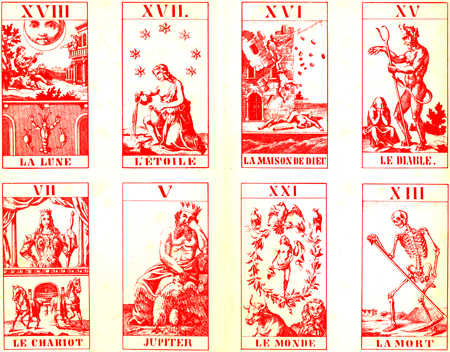
“Tarot cards are believed to have originated in Italy about five centuries ago for several purposes: to provide a pictorial presentation of the times, to play a card game involving suit trumps, and to read and fortell the future. . . .
During the fourteenth century in Italy a tarot pack was used to play a game called tarocco. The word tarot is the French adaptation of the word tarocco. The ancient 78-card tarot decks generally comprised fifty-six regular playing cards known as the Lesser Arcana, divided into four suits numbered 10 to 1 (or Ace) with a King, Queen, Cavalier and Page. Suit signs were the forerunners of today’s suits:
Swords or Epees = Spades
Batons, Scepters or Wands = Clubs
Cups or Coupes = Hearts
Coins, Deniers or Pentacles = Diamonds
In addition to the fifty-six cards, the tarot decks contained twenty-two pictorial cards known as Trump, Triumph, Atouts, Greater Arcana, or the Major Arcana cards, numbered from XXI to I plus an unnumbered card known as “The Fool.” Most people today are unaware that the ordinary pack of playing cards is a direct descendant from the fourteenth century tarot deck. As card playing increased in popularity the trump cards were dropped, the Cavalier and Page cards were combined into today’s Jack, and “The Fool” became the Joker, thus giving us the standard deck of fifty-two cards plus joker.”
—S.R. Kaplan, Tarot Cards for Fun and Fortune Telling, 1970. The French cards pictured above are Major Arcana from the Tarot IJJ deck.
The classic pen
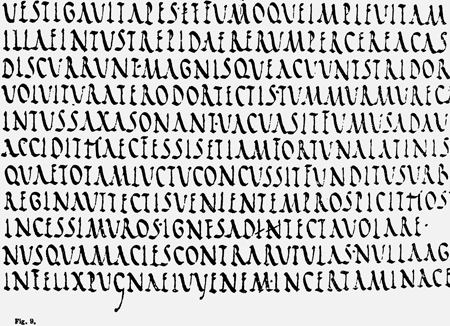
“The classic pen was not a point, it was an edge; and a stiffish one too, and was not pressed upon appreciably. . . .
This tool was certainly established by the third century B.C, and was most usually made of reed (though metal pens of Roman make have been found), or of quill. . . .
Preceding either was no doubt a tool for scratching or cutting stone or bone, which became that chisel with which the magnificent Greek and Roman inscriptions were executed. . . . In only one detail of their draughtmanship is the chisel’s effect now evident, in what we call the serifs, or little finishing touches to heads and feet. . . . There was no occasion for the chisel to make strokes thin and thick except to conform to the standard set by the pen; and, indeed, we see that in the earlier Greek inscriptions, before this standard was acknowledged, the strokes are . . . fairly uniform in thickness.”
—Graily Hewitt, Lettering For Students & Craftsmen, 1930. Figure 9: “Rustic” Roman capitals from the third or fourth century.
the Old Man
“[H]e (the old man) had recovered from his debauch, back in banks again, the Old Man, rippling placidly toward the sea, brown and rich as chocolate between levees whose inner faces were wrinkled as though in a frozen and aghast amazement, crowned with the rich green of summer in the willows; . . .”
—William Faulkner, The Wild Palms, 1939.
And then fall will come
“‘And then fall will come, the first cold, the first red and yellow leaves drifting down, the double leaves, the reflection rising to meet the falling one until they touch and rock a little, not quite closing. . . .’”
—William Faulkner, The Wild Palms, 1939.
red-and-yellow retrograde
“But the days themselves were unchanged—the same stationary recapitulation of golden interval between dawn and sunset, the long quiet identical days, the immaculate monotonous hierarchy of noons filled with the sun’s hot honey, through which the waning year drifted in red-and-yellow retrograde of hardwood leaves sourceless and going nowhere.”
—William Faulkner, The Wild Palms, 1939.
a diamond the size of a ping-pong ball
“Then he began to watch Charlotte and now they all watched her . . . as she . . . began to draw swiftly . . . an enormous man . . . sitting behind a table heaped with glittering coins which the man was shovelling into a sack with a huge hand on which glittered a diamond the size of a ping-pong ball.”
—William Faulkner, The Wild Palms, 1939.
Lookin’ for the heart of Saturday night
“Stoppin’ on the red
You’re goin’ on the green
’Cause tonight’ll be like nothin’
You’ve ever seen
And you’re barrelin’ down the boulevard
Lookin’ for the heart of Saturday night”
—Tom Waits, (Looking For) The Heart of Saturday Night, 1974.
word of the year
“SPRINGFIELD, Mass. (AP) – After 12 months of naked partisanship on Capitol Hill, on cable TV and in the blogosphere, the word of the year for 2006 is . . . “truthiness.”
The word—if one can call it that—best summed up 2006, according to an online survey by dictionary publisher Merriam-Webster.
“Truthiness” was credited to Comedy Central satirist Stephen Colbert, who defined it as “truth that comes from the gut, not books.”. . .
Colbert, who once derided the folks at Springfield-based Merriam-Webster as the “word police” and a bunch of “wordinistas,” was pleased.
‘Though I’m no fan of reference books and their fact-based agendas, I am a fan of anyone who chooses to honor me,’ he said in an e-mail to The Associated Press.”
—Adam Gorlick, Associated Press Writer, Friday December 8, 2006.
her eyes
“He told her and now she looked at him and he saw that her eyes were not hazel but yellow, like a cat’s, staring at him with a speculative sobriety like a man might, intent beyond mere boldness, speculative beyond any staring.”
—William Faulkner, The Wild Palms, 1939.