dots of blue and gray and green
“She took off her dark glasses and squinted at me. It was as though her eyes were shattered prisms, the dots of blue and gray and green like broken bits of sparkle.”
—Truman Capote, Breakfast at Tiffany’s, 1958. The eyes are those of Holly Golightly, of course.
the mean reds
“‘Listen. You know those days when you’ve got the mean reds?’
‘Same as the blues?’
‘No,’ she said slowly. ‘No, the blues are because you’re getting fat or maybe it’s been raining too long. You’re sad, that’s all. But the mean reds are horrible. You’re afraid and you sweat like hell, bu you don’t know what you’re afraid of. Except something bad is going to happen, only you don’t know what it is. You’ve had that feeling?’
‘Quite often. Some people call it angst.’
‘All right. Angst. But what do you do about it?’”
—Truman Capote, Breakfast at Tiffany’s, 1958.
white hair and diamonds
“‘[I]t’s tacky to wear diamonds before you’re forty; and even that’s risky. They only look right on the really old girls. Maria Ouspenskaya. Wrinkles and bones, white hair and diamonds: I can’t wait.’”
—Truman Capote, Breakfast at Tiffany’s, 1958.
The morning light
“The morning light seemed refracted through her: as she pulled the bed covers up to my chin she gleamed like a transparent child; then she lay down beside me. ‘Do you mind? I only want to rest a moment. So let’s don’t say another word. Go to sleep.’”
—Truman Capote, Breakfast at Tiffany’s, 1958.
Biz Barbie
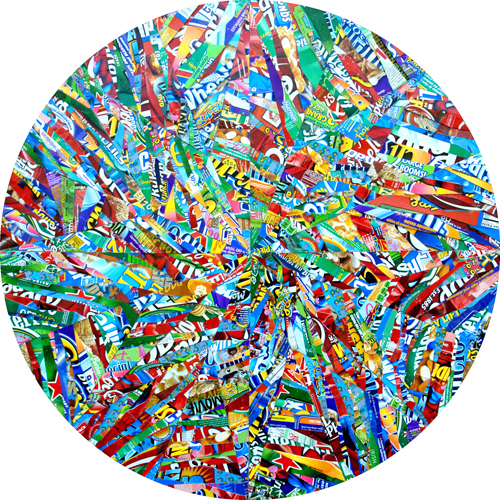 Biz Barbie, 30″x30″, collage, 2008. The fifth in a series of ‘large diamonds,’ I finished this just in time for Recent Works: LSU School of Art Faculty Exhibition, a new show at the LSU School of Art Gallery, at the Shaw Center, conveniently located in beautiful downtown Baton Rouge. The opening is tonight, from 6-8 pm.
the Zen doctrine bearing most directly on the tea aesthetic
“[P]erhaps the Zen doctrine bearing most directly on the tea aesthetic is the emphasis on the mundane as a sphere of action and a source of beauty. The Buddha nature, hence the path to Enlightenment, is to be found in every sentient being and in the most everyday activities. Extending this exaltation of the mundane to the aesthetic realm, Zen describes a fusion of opposites in which the beautiful and the ordinary are no longer distinct. This leads to the aesthetic appreciation of imperfection and poverty, of sabi and wabi. Inasmuch as the qualities can be defined, sabi is the beauty of the imperfect, the old, the lonely, while wabi is the beauty of simplicity and poverty.”
—Dorinne Kondo, The Way of Tea: A Symbolic Analysis, from Empire of the Senses: The Sensual Culture Reader, edited by David Howes, 2005.
pure sabi-wabi
“The tea room itself, for example, embodies pure sabi-wabi:
‘The tea hut is extremely bare and almost devoid of color. IF a flower is arranged in a vase, it is usually a single, small blossom of some quiet hue or white. The tea utensisls are not of exauisite porcelain but of coarse pottery, often a dull brwon or black and imperfectly formed. The dettle may be a little rusty. Yet from these objects we receive an impression not of gloominess or shappiness but one of quet harmony and peace. . . .’”
—Dorinne Kondo, in the endnotes of The Way of Tea: A Symbolic Analysis, quoting Sources of Japanese Tradition, 1958; from Empire of the Senses: The Sensual Culture Reader, edited by David Howes, 2005.
one phrase not yet burned
“Under the bed I discovered a whole shoebox full of love letters from the blond majorette from Belle Prairie Plantation; I took them in the back yard, arranged them in a neat pile near the place where my dog Skip was buried . . . and put a match to them, gazing down at one phrase not yet burned: ‘I’ll meet you in front of the drugstore at 7:30 in my green sweater.’”
—Willie Morris, North Toward Home, 1967.
XTT Part 2: Anatomy of a Letterform

Lynda Barry
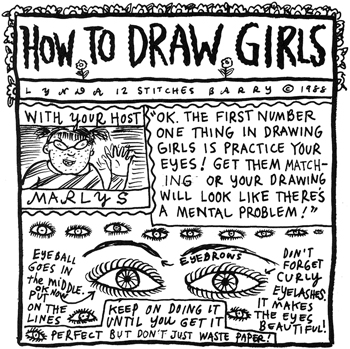
I’ve been quoting a lot of Ms Barry lately. She’s great! She’s funny, and she’s serious. She’s punk rock, which means that she is low-budget, unpretentious, sincere, and willing to share the means of production with her audience. My favorite Lynda Barry book is One! Hundred! Demons!, from 2002, but a new book What It Is, is due to be released in May. (If you’re curious, a free PDF preview is available here.)