two souls in one body
“The self-conscious feedback mechanism of the cortex allows us the hallucination that we are two souls in one body—a rational soul and an animal soul, a rider and a horse, a good guy with better instincts and finer feelings and a rascal with rapacious lusts and unruly passions. Hence the marvelously involved hypocrisies of guilt and penitence, and the frightful cruelties of punishment, warfare, and even self-torment in the name of taking the side of the good soul against the evil. The more it sides with itself, the more the good soul reveals its inseparable shadow, and the more it disowns its shadow, the more it becomes it.”
—Alan Watts, The Book: On the Taboo Against Knowing Who You Are, 1966.
China Facing Olympic Heat
China struggles with Tibetan unrest
Vernacular Baton Rouge: PERSONAL TOUCH

A greenish-white light
“Otoko went out on the veranda and kicked a cage of fireflies into the garden with her bare foot.
All the fireflies seemed to glow at once. A greenish-white light was streaming out as the cage landed on a patch of moss. The sky was clouding at the end of a long summer day, and an evening haze had begun to hover faintly over the garden, but it was still daylight. It seemed unlikely that the fireflies could have glowed so brilliantly, perhaps she had only imagined the light streaming out of the cage, perhaps it had been conjured up by her own feelings. She stood there rigidly as if paralyzed and stared unblinkingly at the firefly cage lying on its side on the moss.”
—Yasunari Kawabata, Beauty & Sadness, translated by Howard Hibbett, 1975.
A purple sunset
“Oki was standing on a low hill, his gaze held by the purple sunset. . . . A purple sunset was most unusual. There were subtle gradations of color from dark to light, as if blended by trailing a wide brush across wet rice paper. The softness of the purple implied the coming of spring. At one place the haze was pink. That seemed to be where the sun was setting.”
—Yasunari Kawabata, Beauty & Sadness, translated by Howard Hibbett, 1975.
The great globe of the sky
“No life was now in sight: even no ship upon the pale blue sea. The great globe of the sky was unblemished and royal in its blueness and its ringing cerulean light.”
—D.H. Lawrence, Sea and Sardinia, 1923.
dark eyes
“There are fascinating dark eyes in Sicily, bright, big, with an impudent point of light and curious roll, and long lashes: the eyes of old Greece, surely. But here one seen eyes of soft, blank darkness, all velvet, with no imp looking out of them. And they strike a stranger, older note: before the soul became self-conscious: before the mentality of Greece appeared in the world. Remote, always remote, as if the intelligence lay deep within the cave, and never came forward. One searches in to the gloom for a second, while the glance lasts. But without being able to penetrate to the reality. It recedes, like some unknown creature, deeper into its lair. There is a creature, dark and potent, But what?”
—D.H. Lawrence, Sea and Sardinia, 1923.
Italian khaki
“Usually . . . the peasants of the South have left off the costume. Usually it is the invisible soldier’s grey-green cloth, the Italian khaki, this grey-green war clothing. How many millions of yards of the thick, excellent, but hateful material the Italian Government must have provided I don’t know: but enough to cover Italy with a felt carpet, I should think. It is everywhere. It cases the tiny children in stiff and neutral frocks and coats, it covers their extinguished fathers, and sometimes it even encloses the women in its warmth. It is symbolic of the universal grey mist that has come over men, the extinguishing of all bright individuality, the blotting out of all wild singleness. Oh, democracy! Oh, khaki democracy!”
—D.H. Lawrence, Sea and Sardinia, 1923.
A.R.
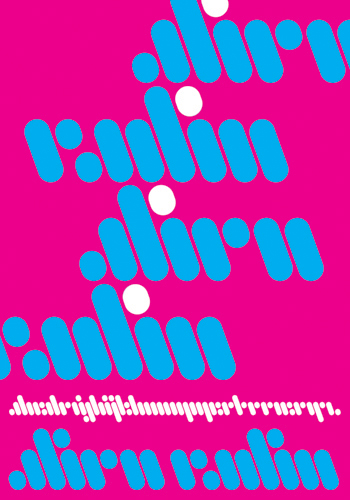 It didn’t make the preceding top 100 list, but here’s my best schrift, my only schrift actually: Alien Radio, a font that I designed about ten years ago with a lot of help from Tal Leming. It was inspired by the Warner Brothers cinematic w logo, but at least I admit it. Functional? Probably not. A.R. takes the fun right out of functional. When a precise literal rendering of a text is essential to your communication, Alien Radio will probably not be your best font choice. But when you want to be cryptic and cool, post-modern to the point of invisibility; when you want to suggest communication without referencing anything specific, when legibility hardly matters anyway—consider A.R.