Besten Schriften
Die 100 Besten Schriften aller Zeiten.
Farkitrol®
“You CAN go to the beach. Farkitrol® can help.”
The green and vivid-coloured world of fruit-gleams
“Peasant women, sometimes barefoot, sat in their tight little bodices and voluminous, coloured skirts behind the piles of vegetables, and never have I seen a lovelier show. The intense deep green of spinach seemed to predominate, and out of that came the monuments of curd-white and black-purple cauliflowers: but marvellous cauliflowers, like a flower show, the purple ones intense as great bunches of violets. From this green, white and purple massing struck out the vivid rose-scarlet and blue-crimson of radishes, large radishes like little turnips in piles. Then the long, slim, grey-purple buds of artichokes, and dangling clusters of dates, and piles of sugar-dusty white figs and sombre-looking black figs, and bright burnt figs: basketfuls and basketfuls of figs. A few baskets of almonds, and many of walnuts. Basket-pans of native raisins. Scarlet peppers like trumpets: magnificent fennels, so white and big and succulent: baskets of new potatoes: scaly kohlrabi: wild asparagus in bunches, yellow-budding sparacelli: big, clean-fleshed carrots: feathery saldas with white hearts: long, brown-purple onions, and then, of course, pyramids of big oranges, pyramids of pale apples, and baskets of brilliant shiny mandarini, the little tangerine oranges with their green-black leaves. The green and vivid-coloured world of fruit-gleams I have never seen in such splendour as under the market roof at Cagliari: so raw and gorgeous. And all quite cheap. . . .”
—D.H. Lawrence, Sea and Sardinia, 1923.
lemons, lemons, innumerable
“The lemons hang pale and innumerable in the thick lemon groves. Lemon trees, like Italians, seem to be happiest when they are touching one another all round. Solid forests of not very tall lemon trees lie between the steep mountains and the sea, on the strip of plain. Women, vague in the orchard under-shadow, are picking the lemons, lurking as if in the undersea. There are heaps of pale yellow lemons under the trees. They look like pale, primrose-smouldering fires. Curious how like fires the heaps of lemons look, under the shadow of foliage, seeming to give off a pallid burning amid the suave, naked, greenish trunks. When there comes a cluster of orange trees, the oranges are red like coals among the darker leaves. But lemons, lemons, innumerable, speckled like innumerable tiny stars in the green firmament of leaves. So many lemons!”
—D.H. Lawrence, Sea and Sardinia, 1923.
a universe on fire
“Some light penetrated very weakly into my consciousness again, a tiny
ray of sunlight, making me ecstatically warm. More sunlight flowed in,
a gentle delicate silky light, which brushed so sweetly against me.
Then the sun grew stronger and stronger, blazing brilliantly on my
temples, piercing with heavy and burning heat into my emaciated brain.
At the end a mad open fire blazed up before my eyes, a heaven and an
earth ignited, men and animals of fire, mountains of fire, devils of
fire, a chaos, a wilderness, a universe on fire, a smoking final day.”
—Knut Hamsun, Hunger, 1890; translation by Robert Bly, 1967.
bracing their heels against a comma
“Some flies and gnats were sitting on my paper and this disturbed me; I breathed on them to make them go, then blew harder and harder, but it did no good. The tiny beasts lowered their behinds, made themselves heavy, and struggled against the wind until their thin legs were bent. They were absolutely not going to leave the place. They would always find something get hold of, bracing their heels against a comma or an unevenness in the paper, and they intended to stay exactly where they were until they themselves decided it was the right time to go.”
—Knut Hamsun, Hunger, 1890; translation by Robert Bly, 1967.
clear and bright
“The air was clear and bright and my mind was without shadow.”
—Knut Hamsun, Hunger, 1890; translation by Robert Bly, 1967.
The multimedia magazine in a box
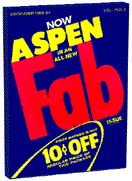
Aspen. The multimedia magazine in a box.
symbolic thought
“The fundamental innovation that we see with the Cro-Magnons and their African precursors is that of symbolic thought, and this is something with which language is virtually synonymous. Like thought, language involves forming and manipulating symbols in the mind, and our capacity for symbolic reasoning is almost inconceivable in its absence. Imagination and creativity are part of the same process, for only once we have created mental symbols can we combine them in new ways and ask ‘what if?’ . . .
[T]here’s little doubt that it is symbolic thought that above all differentiates us . . . not only from every other hominid but also from every other organism that has ever existed. . . . [T]he record seems to show that the early history of modern humans was one of the sequential discovery of the things that symbolic thought made possible. This is, indeed, an ongoing process: even today we are discovering new ways in which to employ and express our unprecedented cognitive abilities.”
—Ian Tattersall, The World from Beginnings to 4000 BCE, 2008.
the most ringing declaration of independence ever set down
“[W]hen [agricultural] people beset by climatic vagaries begin to feel at odds with nature, they begin to lose their sense of integration with it. Life becomes a struggle to overcome nature: to modify it and, if at all possible, to dominate it. It is no coincidence that the founding documents of the Judeo-Christian religions, ultimately derived from the early farmers of the Fertile Crescent, contain what Niles Eldredge of the American Museum of Natural History has called ‘the most ringing declaration of independence ever set down.’ This is the passage from the first book of the Bible, Genesis (1: 27), which translates as ‘God said . . . be fruitful, and multiply, and replenish the earth, and subdue it; and have dominion . . . over every living thing that moveth upon the earth.’ The independence declared here is independence of our species from nature itself, based on a profound feeling of separateness from the environment on which we depend.”
—Ian Tattersall, The World from Beginnings to 4000 BCE, 2008.