The world isn’t made of pen, ink, and paper
“‘If I got places, sir, it was because I made myself fit for ’em. If you want to slip into a round hole, you must make a ball of yourself—that’s where it is. . . .
‘The world isn’t made of pen, ink, and paper, and if you’re to get on in the world, young man, you must know what the world’s made of.’”
—George Eliot, The Mill on the Floss, 1860. The advice is from Mr. Deane.
that unfailing source of the terrible
“Nothing but long meditation and preconcerted arrangement of effects could have enabled Tom to present so striking a figure as he did to Maggie when she looked up. Dissatisfied with the pacific aspect of a face which had no more than the faintest hint of flaxen eyebrow, together with a pair of amiable blue-grey eyes and round pink cheeks that refused to look formidable . . . he had had recourse to that unfailing source of the terrible, burnt cork, and had made himself a pair of black eyebrows that met in a satisfactory manner over his nose and were matched by a less carefully adjusted blackness about the chin. He had wound a red handkerchief round his cloth cap to give it the air of a turban, and his red comforter across his breast as a scarf—an amount of red, which, with the tremendous frown on his brow and the decision with which he graped the sword as he held it with its point resting on the ground, would suffice to convey an approximative idea of his fierce and blood-thirsty disposition.
Maggie looked bewildered for a moment, and Tom enjoyed that moment keenly; but in the next, she laughed, clapped her hands together and said, ‘Oh, Tom, you’ve made yourself like Bluebeard at the show.’”
—George Eliot, The Mill on the Floss, 1860.
Space: The Lost Atlantis
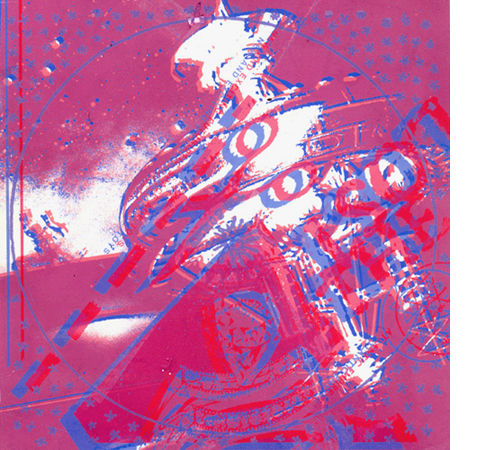 Hey kids, get out your red and blue anaglyph 3-D glasses for this fresh and novel illusionary experience: a stereo collage from visionary artist and reluctant earthling Paul Dean! Of course, stereo illusions are nothing new, and even this collage is several years old. I made it in 2004 or 2005, at the tail end of the intensely personal creative exploraganza that I call my Alien Radio phase. (If you listen very very carefully, you can almost hear the aliens singing.)
Anyway, this piece seemed so nearly finished that I thought what the heck! I tweaked the color a bit, (ok, I tweaked it a lot), I cropped it, and I am hereby revealing to the world a little something I call Space: The Lost Atlantis.
the thorny wilderness
“They had entered the thorny wilderness, and the golden gates of their childhood had forever closed behind them.”
—George Eliot, The Mill on the Floss, 1860.
stop twice as long at a semicolon
“‘I told you girls couldn’t learn Latin. It’s “Nomen non crescens genitivo.”’
‘Very well, then,’ said Maggie, pouting. ‘I can say that as well as you can. And you don’t mind your stops. For you ought to stop twice as long at a semicolon as you do at a comma, and you make the longest stops where there ought to be no stop at all.’”
—George Eliot, The Mill on the Floss, 1860.
a blue ground with a white spot
“‘Jane and me were allays contrairy; she would have striped things, and I like spots. You like a spot too, Bessy; we allays hung together i’ that.’
‘Yes, Sophy,’ said Mrs. Tulliver, ‘I remember our having a blue ground with a white spot both alike—I’ve got a bit in a bed-quilt now; . . .’”
—George Eliot, The Mill on the Floss, 1860. You might have noticed three semicolons in that snippet. Semicolons were good enough for George Eliot!
sheet after sheet of silver paper
“The delicious scent of rose-leaves that issued from the wardrobe made the process of taking out sheet after sheet of silver paper quite pleasant to assist at, though the sight of the bonnet at last was anticlimax to Maggie, who would have preferred something more strikingly preternatural.”
—George Eliot, The Mill on the Floss, 1860.
a very nice heaven
“There was nothing to mar her delight in the whispers and the dreamy silences when she listened to the light dipping sounds of the rising fish and the gentle rustling, as if the willows and the reeds and the water had their happy whisperings also. Maggie thought it would make a very nice heaven to sit by the pool in that way and never be scolded. She never knew she had a bite till Tom told her, but she liked fishing very much.”
—George Eliot, The Mill on the Floss, 1860.
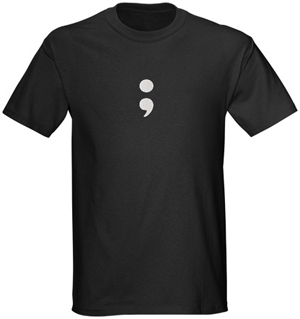
a Semicolon Appreciation Society
the punctuation mark of our era
“While the bullet point’s existence certainly predates PowerPoint, in popularity it is a curious byproduct of the computer program. Until recently it was merely a typographical mark, a solid dot, used in a particular kind of list, usually in an advertising context, to distinguish items of equal weighting. Typesetters would have created bullets by filling lower case o’s or by using various dingbats. Now, a plethora of Web sites exists to advise upon its usage: according to one, by adding emphasis to a list with bullets or icons (in PowerPoint you can select animated or sound ones) your list takes on new importance and invites readership. It has become an increasingly noisy sign that requests, with more urgency than a new paragraph can muster, the renewed and exaggerated attention of a reader: ‘Read This Now!’ it seems to demand. Despite the bullet’s mysterious past—in typographic histories its origins are either guessed at or omitted completely—and the fact that there is no bullet point button on the computer keyboard (it’s Option 8 on Macs and Alt-0149 on Windows); it has somehow finagled its way into popular usage to the extent that it is now the punctuation mark of our era.”
—Alice Twemlow, From the (A) Trivial to the (B) Deadly Serious, Lists Dominate Visual Culture, 2003; from Looking Closer Five: Critical Writings on Graphic Design, 2006.