The best blog in the world
Having just finished reading Erik Ringmar’s A Blogger’s Manifesto (see previous posts) I feel compelled to toss onto the site a few words of my own. The best blog in the world is I Just Want To Be A Tugboat Captain, and it’s pure coincidence that I happen to know its author. He was a graphic design student of mine about a dozen years ago. He was a good student, and when he graduated he moved to New Orleans and worked as a professional graphic designer at a very pleasant and successful graphic design firm.
But . . . oddly . . . he wasn’t satisfied with his life. He joined the Peace Corps for a year or two, and then . . . but I don’t want to give it all away. His name is Dave . . . and he Just Wants To Be A Tugboat Captain. Check it out!
the most beautiful of all American flags

—John McPhee, Coming into the Country, 1977.
‘Alaska furniture’
“There were two rooms, full of period ‘Alaska furniture’ made from orange crates, Blazo boxes, and egg crates.”
—John McPhee, Coming into the Country, 1977.
that flying white mountain
“If you were looking toward Mount Everest from forty miles away, you would lift your gaze only slightly to note the highest in a sea of peaks. Forty miles from McKinley you can stand at a bench mark of three hundred feet and climb with your eyes the other twenty thousand feet. The difference—between your altitude near sea level and the height of that flying white mountain—is much too great to be merely overwhelming. The mountain is a sky of rock, seemingly all above you, looming. Until it takes itself away, you watch it as you might watch a hearth fire or a show in color of aurorean light.”
—John McPhee, Coming into the Country, 1977.
‘thought-stingers’
“The easiest way for college professor ‘bees’ to administer their ‘idea poison’ is through their ‘thought-stingers,’ commonly called ‘books.’”
—Stephen Colbert, I Am America (And So Can You!), 2007.
Patterns
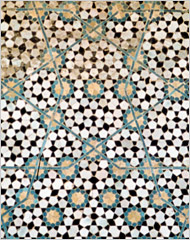 “I was 3 or 4 years old. I was playing in the garden when a brilliant,
shimmering light appeared to my left — dazzlingly bright, almost as
bright as the sun. It expanded, becoming an enormous shimmering
semicircle stretching from the ground to the sky, with sharp zigzagging
borders and brilliant blue and orange colors. Then, behind the
brightness, came a blindness, an emptiness in my field of vision, and
soon I could see almost nothing on my left side. I was terrified — what
was happening? My sight returned to normal in a few minutes, but these
were the longest minutes I had ever experienced.”
—Oliver Sacks, from Patterns, a look at visual migraines published just today at the New York Times. Oliver Sacks is brilliant, of course, and the article is well worth your time. If you’re into these things.
The War On The War On
“In the latter half of the 20th century, Americans were called to meet
abstractions with metaphors in a series of gaudy figurations popularly
called ‘The War On . . .’” So begins The War On The War On.
Iune Wind
Poppin’
the bark of the root of mandrake
“By and by Dr. Claypool laid down his pen and read the result of his labors aloud, carefully and deliberately, for this battery must be constructed on the premises by the family, and mistakes could occur; for he wrote a doctor’s hand—the hand which from the beginning of time has been so disastrous to the apothecary and so profitable to the undertaker:
‘Take of afarabocca, henbane, corpobalsamum, each two drams and a half: of cloves, opium, myrrh, cyperus, each two drams; of opobalsamum, Indian leaf, cinnamon, zedoary, ginger, coftus, coral, cassia, euphorbium, gum tragacanth, frankincense, styrax calamita, celtic, nard, spignel, hartwort, mustard, saxifrage, dill, anise, each one dram; of xylaloes, rheum ponticum, alipta, moschata, castor, spikenard, galangals, opoponax, anacardium, mastich, brimstone, peony, eringo, pulp of dates, red and white hermodactyls, roses, thyme, acorns, pennyroyal, gentian, the bark of the root of mandrake, germander, valerian, bishop’s weed, bay-berries, long and white pepper, xylobalsamum, carnabadium, macedonian, parsley-seeds, lovage, the seeds of rue, and sinon, of each a dram and half; of pure gold, pure silver, pearls not perforated, the blatta byzantina, the bone of the stag’s heart, of each the quantity of fourteen grains of wheat; of sapphire, emerald and jaspers stones, each one dram; of hazel-nut, two drams; of pellitory of Spain, shaving of ivory, calamus odoratus, each the quantity of twenty-nine grains of wheat; of honey or sugar a sufficient quantity. Boil down and skim off.’”
—Mark Twain, Those Extraordinary Twins, 1894.