Blue Monk
Jazz Casual
A Night in Tunisia
The bee’s knee
If you don’t know me personally, then you might not know that I have been writing an essay on the terminology of typography which I plan to submit to Verbatim, an academic lexicographic quarterly. I’m as over-ambitious for this project as I have ever been for any project, so I am determined to create a humorous but thorough and perhaps even a profound work. A comic typographic Moby Dick, if you will.
Last night I finished it. Or I went to bed thinking I had. But this morning I was bothered by an inkling of one last term, but one that I was not at all sure of. It involved a colon and a dash, and had something to do with two balls, and a prick. So I googled two balls and a prick. The results I were interesting, but I found no reference whatsoever to punctuation or typography.
Then I googled punctuation and colon and I was onto something. Yes, the combination of a colon and a dash, which at one time was fairly common but has now been replaced by just the colon, is sometimes referred to, according to a post at a discussion group, as a colon-dash or a dog’s prick. A dog’s prick! But no, this gets stranger. The Partridge Dictionary of Slang, according to another person, defines a dog’s prick as typographic slang for an exclamation mark! Could it refer to both, I wondered?
Well, no. According to the 1949 third edition of the Partridge Dictionary of Slang, “the typographical colon-dash (:—)” is sometimes referred to as dog’s ballocks. And the Oxford English Dictionary, in an online ‘draft revision’ dated July 2007, concurs:
“dog’s bollocks n. (also dog’s ballocks) Brit. coarse slang (a) Typogr. a colon followed by a dash, regarded as forming a shape resembling the male sexual organs (see quot. 1949) (rare); (b) (with the) the very best, the acme of excellence; cf. the cat’s whiskers at CAT n.1 13l, bee’s knee n. (b) at BEE n.1 5b.”
The bee’s knee. How could I have possibly thought, last night, that the essay was complete.
=|:-)=
“=|:-)= This e-mail is being monitored by Uncle Sam for your protection.“ An emoticon from The New Yorker. Thank you Jim Kellough!
an ‘e’ tax
“We need to do something about this national tendency to try to make new things look like they are old.
First off, we should enact an ‘e’ tax. Government agents would roam the country looking for stores whose names contained any word that ended in an unnecessary ‘e,’ such as shoppe or olde, and the owners of these stores would be taxed at a flat rate of $50,000 per year per ‘e.’ We should also consider an additional $50,000 ‘ye’ tax, so that the owner of a store called ‘Ye Olde Shoppe’ would have to fork over $150,000 a year. In extreme cases, such as ‘Ye Olde Barne Shoppe,’ the owner would simply be taken outside and shot.”
—Dave Barry, Ye Olde Humor Columne, from Dave Barry’s Greatest HIts, 1988.
hints and symbols
“Perhaps, I thought, while her words still hung in the air between us like a wisp of tobacco smoke—a thought to fade and vanish like smoke without a trace—perhaps all our loves are merely hints and symbols; a hill of many invisible crests; doors that open as in a dream to reveal only a further stretch of carpet and another door; perhaps you and I are types and this sadness which sometimes falls between us springs from disappointment in our search, each straining through and beyond the other, snatching a glimpse now and then of the shadow which turns the corner always a pace or two ahead of us.”
—Evelyn Waugh, Brideshead Revisited, 1945.
Vernacular Baton Rouge: The TURKISH BATHS
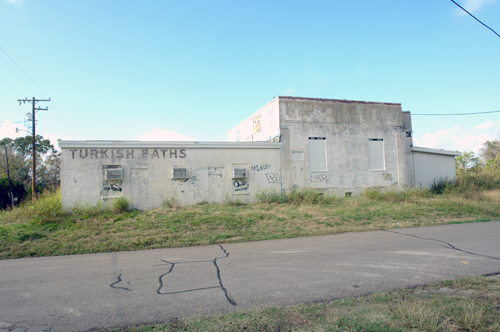
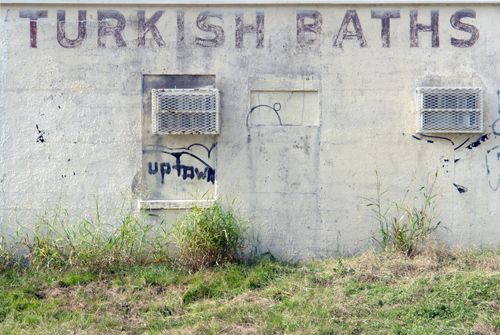 The TURKISH BATHS. A central Baton Rouge landmark, just south of the I-10 bridge. For a decade or two, a decade or two ago, it was a practice space for many a Baton Rouge band. I took these pictures to catch the old signage, having heard by way of Culture Candy that the building was destined to become a contemporary art ‘House Project’ before its demolition.
Sadly, the House Project team is now looking for another building to ‘project,’ because they have been informed that the demolition and razing of the Turkish Baths has been ‘moved forward,’ meaning, I suppose, that the building will be quite gone soon. Yes, Chloe, it’s the end of another area.
a great Mediterranean moment
“The art world tends to be driven by its market, and throughout the ’50s and the ’60s it was a relatively small art world with dealers and collectors and one or two small museums. It was during that period that the most powerful and permanent American art in this century was made—from Abstract Expressionism and Pop, to Minimalism and Post-Minimalism. It was, in a real sense, a great Mediterranean moment created by 4000 heavily medicated human beings. And then in the late ’60s we had a little reformation privileging museums over dealers and universities over apprenticeship, a vast shift in the structure of cultural authority. All of a sudden rather than an art world made up of critics and dealers, collectors and artists, you have curators, you have tenured theory professors, a public funding bureaucracy—you have all of these hierarchical authority figures selling a non-hierarchical ideology in a very hierarchical way. This really destroyed the dynamic of the art world in my view, simply because like most conservative reactions to the ’60s it was aimed specifically at the destruction of sibling society—the society of contemporaries.”
—Dave Hickey, talking with Sari Karel at zingmagazine.
the Alice-in-Wonderland side of religion
“‘But of course,’ she said, ‘it’s very unexpected for a camel to
go through the eye of a needle, but the gospel is simply a catalogue of
unexpected things. It’s not to be expected that an ox and an
ass should worship at the crib. Animals are always doing the oddest
things in the lives of the saints. It’s all part of the poetry, the
Alice-in-Wonderland side, of religion.’”
—Evelyn Waugh, Brideshead Revisited, 1945.