the Great White Way
“As they sped downtown past 59th Street, they began to see pepole in multitudes, they began to see a sea of heads weaving underneath lights unlike the lights they had already seen. These lights were a blazing daytime in themselves, a magical universe of lights sparkling and throbbing with the intensity of a flash explosion. They were white like the hard white light of a blowtorch, they were the Great White Way itself.”
—Jack Kerouac, The Town and the City, 1950.
Vernacular Baton Rouge 3

A Baton Rouge slash Coca-Cola classic.
a dark blue mood
“It was Friday night. I was tooling home from the Mexican border in a light blue convertible and a dark blue mood.”
—Ross Macdonald, The Singing Pigeon, 1953.
Death was in the the dream
“I must have dozed for a few minutes. A dream rushed by the threshhold of my consciousness, making a gentle noise. Death was in the the dream. He drove a black Cadillac loaded with flowers.”
—Ross Macdonald, The Singing Pigeon, 1953.
a beautiful winking wonder
“Then, a golden mystery upheaved itself on the horizon, a beautiful winking wonder that blazed in the sun, of a shape that was neither Muslim dome nor Hindu temple-spire. It stood upon a green knoll, and below it were lines of warehouses, sheds, and mills. Under what new god, thought I, are we irrepressible English sitting now”
—Rudyard Kipling describing the Shwedagon Pagoda in From Sea to Sea and Other Sketches—Letters of Travel vol. 1, 1899.
Shwedagon Pagoda
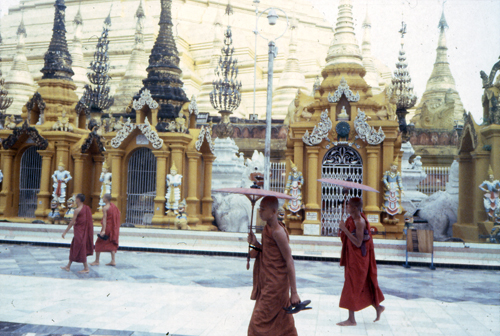
The Shwedagon Pagoda is a massive golden stupa, in Yangon (Rangoon), Myanmar (Burma). (Darn this endless double-naming!) According to Wikipedia, “The crown or umbrella is tipped with 5, 448 diamonds and 2,317 rubies. The very top, the diamond bud, is tipped with a 76 carat (15g) diamond.” In the background of this picture you can see the base of the stupa, and surrounding it is an enormous complex that buzzed with the activity of monks, worshippes and tourists and reminded me of (no disrepect to this sacred site intended) the North Carolina State Fair.
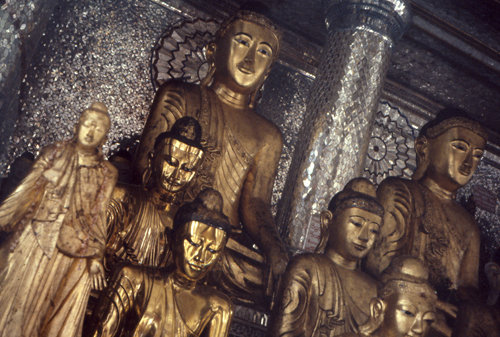
Bagan
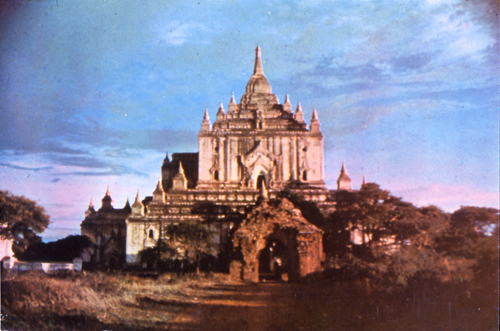
At the airport as I was leaving Burma, I spent my last few kyats (“chats”) on a souvenir picture postcard of one of the thousands of temples in Bagan, which I had visited just a few days earlier. The color does not seem oversaturated to me. It strkes me as just right. Perfect. Bagan (“Pah-garn”) is an amazing place.
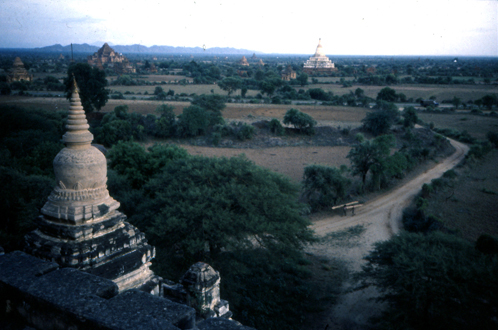
At one time there were over 13,000 temples on this plain in central Burma, on the east bank of the wide and muddy Irrawady (properly the Ayeyarwady) River. About 2,200 of these temples remain standing today. It is not until you climb to the top of one of them that the rest of them are revealed. They dot the landscape like jewels. Really, that’s how it feels!
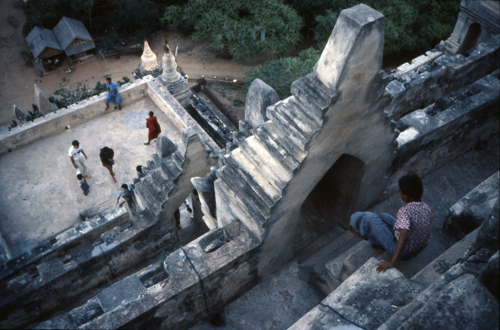
Climbing the temple. Up here some boys tried to sell me some stones, which they said were jewels, rubies I think. The scraped them and showed that they didn’t scratch. They said they would take anything for them, but I (foolishly) wasn’t interested.
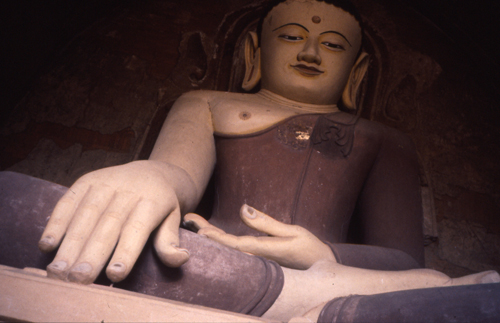
A massive Buddha in the base of one of the temples. You had to wander about, into the shadows, to find the doorways and stairways to the next level. There was a feeling of real adventure about this place. Like Indiana Jones, but that was just a movie!
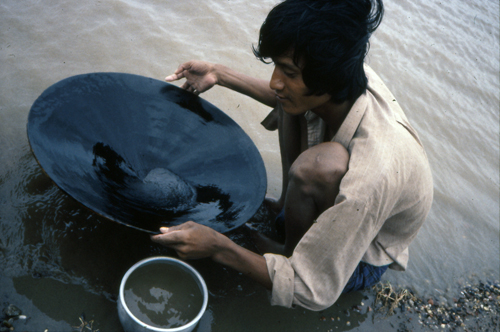
Panning for gold by the Irrawaddy river.
The world’s largest book
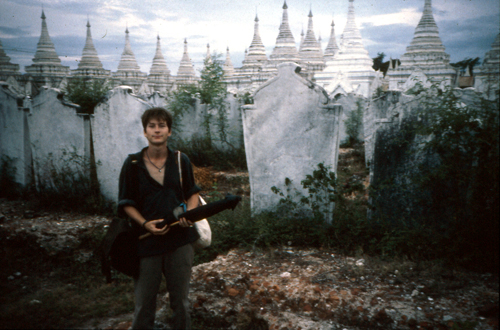
The world’s largest book stands at the foot of Mandalay Hill in Mandalay, Burma. The text is carved and inscribed in gold, in the Burmese abugida script, into both sides of 730 stone tablets, for a total of 1460 “pages.” Each stone tablet stands under a white structure with its own roof with a precious gem on top, and these structures are arranged around a larger golden pagoda. The carefully edited text is the Tipitaka Pali canon of Theravada Buddhism. Construction on this enormous project began in 1860 and was completed in 1868. I visited it in 1986. It was a grey day and as I recall was no one at all on the grounds, tourist or local, as a friend and I explored it. It was run-down, but there were signs that someone was caring for it as best they could. As a graphic designer and a book lover I was impressed but saddened. It is an amazing structure, an astonishing thing, really, standing neglected in a dusty corner of the world.
Click here for more pictures and information from Wikipedia.
The Burmese abugida

By way of the Digital Traveler, here’s a picture of a storefront in Rangoon, Myanmar. The name Myanmar suggests that the picture was taken after June 18, 1989, when the ruling junta changed the name of the country from Burma to Myanmar. The striking circular letterforms are Burmese characters. (Let’s hope they will never be designated “Myanmarian.”)
Here’s what I just learned about the Burmese alphabet at Wikipedia:
It is properly called the Burmese abugida, and the characters are round because straight lines would have ripped the palm leaves on which it was traditionally written. There are 33 consonants, but the last letter in this alphabet—although recognized as a consonant, is actually a vowel,—and this secret vowel can furthermore be used to indicate other vowels.
This alphabet reads from left to right, just as English does. There are no spaces between words, but when casually written there are sometimes spaces between phrases. The puctuation is limited to two characters, one or two downward strokes, which serve as a comma and a period, respectively. (This is perhaps not so strange when you consider that in Roman times, Latin was written without worspaces and without punctuation of any kind.)
The Burmese abugida evolved from the Mon script, which has its roots in the Brahmi script of ancient India, which many academics now believe “had indigenous origins, probably from the Indus Valley (Harrapan) script.” Which is a way of saying that it probably does not share a common ancestor of European scripts, as had long been believed.
sterling insignificance
“He was giving orders for a toothpick-case for himself, and till its size, shape, and ornaments were determined, all of which, after examining and debating for a quarter of an hour over every toothpick-case in the shop, were finally arranged by his own inventive fancy, he had no leisure to bestow any other attention on the two ladies, than what was comprised in three or four very broad stares; a kind of notice which served to imprint on Elinor the remembrance of a person and face, of strong, natural, sterling insignificance, though adorned in the first style of fashion.”
—Jane Austen, Sense and Sensibility, 1811.