the true ‘Mesopotamian heritage’
“In approximately 3300 B.C., about two centuries before the Egyptians, the Sumerians invented writing, [a] fundamental revolution which enabled man to communicate with distant other men; to refine and develop his thoughts; to transmit them from one generation to the other, making them immortal since they were engraved on stones and, more often, on clay, both imperishable materials. Together with the Mesopotamian Semites (Akkadians, Babylonians and Assyrians), the Sumerians used this wonderful tool not only for their accounts, but also to retain memories of the past; to assemble in a coherent system a number of hitherto disparate religious concepts; to honour and serve their gods and obtain from them a glimpse of their own future; to glorify their kings; to codify their laws; to classify the fascinating world around them and lay the foundations for scientific research; to use myths, legend, epic tales and ‘counsels of wisdom’ in order to express their properly philosophical ideas, ranging from the creation of the cosmos and man to the insoluble problem of Good and Evil; and for thousands of other things which cannot be listed here, for no other peoples in pre-classical antiquity has left us so many texts of all kinds. This is the true ”Mesopotamian heritage”. . . .”
—Georges Roux, Ancient Iraq, third edition, 1992.
Fireworks
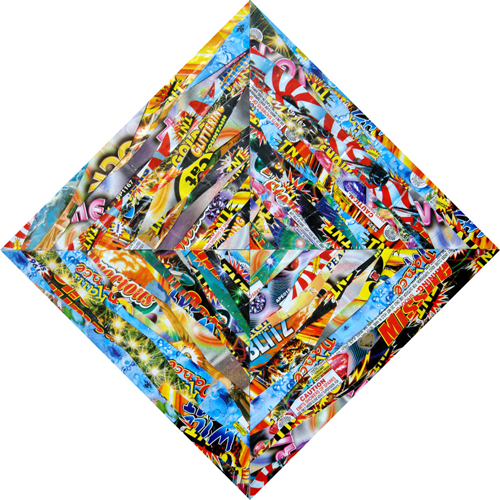
Fireworks, a collage by Paul Dean, 17″x17″, 2007. A present for George and Gail, it includes fireworks packaging from their wedding celebration.
a beautiful dull sheen
“‘But that day I’d seen this iron thing, a little brooch with a beautiful dull sheen, to be worn around the neck, you know how nice that would look on my breast.’—‘On your brown breastbone a dull gold beautiful it would be baby, go on with your amazing story.’”
—Jack Kerouac, The Subterraneans, 1958.
the sea of blackness
“Bear with me all lover readers who’ve suffered pangs, bear with me men who understand that the sea of blackness in a darkeyed woman’s eyes is the lonely sea itself and would you go ask the sea to explain itself. . . ?”
—Jack Kerouac, The Subterraneans, 1958.
the crystal chandelier of eternity
“. . . all thoughts meet in the crystal chandelier of eternity. . . .”
—Jack Kerouac, The Subterraneans, 1958.
two stars in the sky
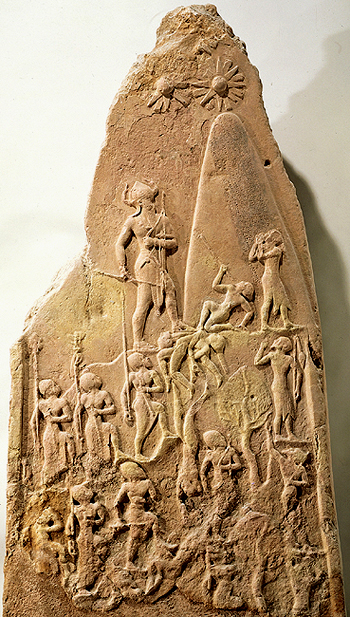
“The Akkadian victory over [the Lullubi] is commemorated by . . . a masterpiece of Mesopotamian sculpture: the famous stele found at Susa [c. 2239 B.C.]. . . . There Naram-Sin, armed with the bow and the horned tiara of the gods on his head, is shown climbing a steep mountain and treading upon the corpses of his enemies; his infantry, pictured on a smaller scale, follows him. The gods, who dwarfed the humans in Early Dynastic Sumerian sculpture, are now, significantly, reduced to discreet symbols: two stars in the sky.”
—Georges Roux, Ancient Iraq, third edition, 1992.
black and shapeless
“Falling on the people who passed in the street, the long, naked, whistling finger of gas in the entrance turned them instantly into ghosts, gaunt or stout, framed in the black doorway. The same passers-by would then go and find themselves a bit of color here and there, in the light of windows or street lamps, and finally lose themselves, as black and shapeless as myself, in the night.”
—Louis-Ferdinand C’line, Journey To The End Of The Night, 1934, translated by Ralph Manheim, 1983.
No more white! No more black!
“‘For one thing, Ferdinand, from the standpoint of a truly modern intelligence, haven’t all differences and distinctions been defaced? No more white! No more black! Everything dissolves. That’s the new approach! The fashion! . . . I saw the human mind, Ferdinand, losing its balance little by little and dissolving in the vast maelstrom of apocalyptic ambitions! It began about 1900 . . . mark that date!’”
—Louis-Ferdinand C’line, Journey To The End Of The Night, 1934, translated by Ralph Manheim, 1983.
communists
“When the red ants discovered that a new variety of canned goods had arrived, they mounted guard around the cassoulet. It wouldn’t have been advisable to leave a freshly opened can standing; they’d have summoned the whole nation of red ants to the shack. There are no bigger communists anywhere.”
—Louis-Ferdinand C’line, Journey To The End Of The Night, 1934, translated by Ralph Manheim, 1983.
great delirious spurts of scarlet
“The sunsets in that African hell proved to be fabulous. They never missed. As tragic every time as a monumental murder of the sun! . . . For a whole hour the sky paraded in great delirious spurts of scarlet from end to end; after that the green of the trees exploded and rose up in quivering trails to meet the first stars. Then the whole horizon turned gray again and then red, but this time a tired red that didn’t last long. That was the end. All the colors fell back down on the forest in tatters, like streamers after the hundredth performance. It happened every day at exactly six o’clock.”
—Louis-Ferdinand C’line, Journey To The End Of The Night, 1934, translated by Ralph Manheim, 1983.