Mars Tyler’s sofa
“The door of Quincy’s office was orange and his sofa was dark gray. Some of us in Weede’s group had doors of the same color but sofas of a different color. Some had identical sofas but different doors. Weede himself was the only one who had a red sofa. Weede and Ted Warburton were the only ones with black doors. But Mars Tyler’s sofa was ecru, a shade lighter than Grove Palmer’s door. I had all this down on paper. On slow afternoons I used to study it, trying to find a pattern. I thought there might be a subtle color scheme designed by management and based on a man’s salary, ability, and prospects for advancement or decline. Why did no two people have identical sofas and doors? Why was Ted Warburton allowed to have a black door when the only other black door belonged to Weede Denney? Why was Reeves Chubb the only one with a primrose sofa? Why was Paul Joyner’s perfectly good maroon sofa replaced by a royal blue one? Why was my sofa the same color as Weede’s door? There were others who felt as I did.”
—Don DeLillo, from Americana, 1971.
an orange tie
“At work I dressed in the establishment manner, which, granted, was not without a touch of color, the establishment having learned that every color is essentially gray as long as everyone is wearing it. So I did not hesitate to show up for work in an orange tie, but never more orange than the orange others wore.”
—Don DeLillo, from Americana, 1971.
graytalk
“In the evening we sat in the camper on Howley Road and listened to the radio. A war summary came on. I did not listen to the news, merely to the words themselves, the familiar oppressive phrases. It was like the graytalk of the network—not what something meant and often not its opposite.”
—Don DeLillo, from Americana, 1971.
colorless
“‘I want to be colorless.’”
—Don DeLillo, from Americana, 1971.
brooch-operas for M’lady
“Tuesday afternoon, Reich left Monarch tower early and dropped in at the Century Audio-bookstore on Sheridan Place. It specialized mostly in piezo-electric crystal recordings . . . tiny jewels mounted in elegant settings. The latest vogue was brooch-operas for M’lady. (‘She Shall Have Music Wherever She Goes.’) Century also had shelves of obsolete printed books.”
—Alfred Bester, from The Demolished Man, 1951.
The Mesopotamian seal
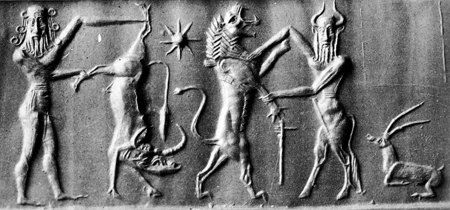
“The Mesopotamian seal has a peculiar shape, a small cylinder engraved on the outside, and thus impressing its distinctive design when rolled over the clay of a tablet or the sealing of a package of merchandise. . . .
The seal engravings, many times more numerous than all the other works of art that have come down to us, disclose most fully the richness and vigour of this first great phase of Mesopotamian culture.”
—Henri Frankfort, The Art and Architecture of the Ancient Orient, fourth edition, 1970. The blank area of the cylinder seal pictured above was for further cuneiform inscription.
a portrait of Maria
“There was a portrait of Maria centered in the star of a synthetic ruby enclosed in the message capsule. A nude portrait, naturally.”
—Alfred Bester, from The Demolished Man, 1951.
the Rainbow House of Chooka Frood
“Number 99 was an eviscerated ceramics plant. During the war a succession of blazing explosions had burst among the stock of thousands of chemical glazers, fused them, and splashed them into a wild rainbow reproduction of a lunar crater. Great splotches of magenta, violet, bice green, burnt umber, and chrome yellow were burned into the stone walls. long streams of orange, crimson, and imperial purple had erupted through windows and dooors to streak the streets and surrounding ruins with slashing brush stronkes. This became the Rainbow House of Chooka Frood.”
—Alfred Bester, from The Demolished Man, 1951.
10 billion trillion trillion carats
“Twinkling in the sky is a diamond star of 10 billion trillion trillion carats, astronomers have discovered.
The cosmic diamond is a chunk of crystallised carbon, 4,000 km across, some 50 light-years from the Earth in the constellation Centaurus.
It’s the compressed heart of an old star that was once bright like our Sun but has since faded and shrunk.
Astronomers have decided to call the star “Lucy” after the Beatles song, Lucy in the Sky with Diamonds.
‘You would need a jeweller’s loupe the size of the Sun to grade this diamond,’ says astronomer Travis Metcalfe, of the Harvard-Smithsonian Center for Astrophysics, who led the team of researchers that discovered it.”
—Dr David Whitehouse, BBC News Online science editor, Monday, 16 February, 2004. Ran into this three year old news by way of Fark. An oldie, but a goodie.
good red weather
“When de sun’s goin down on de horizon, a turtler must look out to de sunset. Supposin you havin a red sunset, and when you look back into de east, you see red above de blue. Well, dat is good weather: moderate weather or calm. Blue above de red means blusterous weather, prob’ly squally or plenty of breeze, and if you see it real gray, dat means blusterous weather, too. Red evenin sky and underneath is dark—well, dat is good red weather.”
—Peter Matthiessen, from Far Tortuga, 1975.