the origin of the modern spectacle
“On the boulevards two men are carrying some immense gilded letters in a handcart; the effect is so unexpected that everyone stops and looks. There is the origin of the modern spectacle. The shock of the surprise effect. To organize a spectacle based on these daily phenomena, the artists who want to distract the crowd must undergo a continual renewal. It is a hard profession, the hardest profession.”
—Fernand Leger, from the essay The Spectacle: Light, Color, Moving Image, Object-Spectacle, 1924, quoted in Modernism: Designing a New World, 1914-1939, edited by Christopher Wilk, 2006.
his Black Square
“When [Kazimir Malevich] first exhibited his Black Square in 1915, he placed it in the corner of a room, in the position that icons occupied in a traditional Russian Orthodox home. In this way he imbued his image with the transcendental qualities of the icon and indicated that it embodied a metaphysical truth.”
—Christina Lodder, the essay Searching for Utopia, from Modernism: Designing a New World, 1914-1939, edited by Christopher Wilk, 2006.
the square and the circle
“[Jan] Tschichold emphasized the basic geometric forms, the square and the circle, which the Russian painter Kasimir Malevich had seen as the ‘fundamental Suprematist elements’. Squares and circles appear in more than half the illustrations of Elementare Typographie; its first double-page spread is bordered by the eight pages of [El] Lissitzky’s Constructivist fairytale, The Story of Two Squares. Lissitzky, describing the upheavals at the time of the First World War, wrote, ‘Into this chaos came Suprematism, extolling the square as the very source of all creative expression.’ When [Theo] Van Doesburg proclaimed, ‘Already many people are using the square’, he was stating a fact. Hans Arp wrote that his wife, Sophie Taeuber, had “discovered” the square in 1916. In Switzerland after the First World War, when they saw the rectangles in foreign magazines such as De Stijl, they though it was ‘a joke, as if everyone who had drawn a square had been forced to yell with ecstasy and excitement’. True to the spirit of Dada, ‘We still decided to register our own squares at the Patent Office’.”
—Richard Hollis, Swiss Graphic Design: The Origins and Growth of an International Style, 1920-1965, 2006.
we write everything in lower case
“we write everything in lower case to save time. and besides, why two alphabets, where one will do? why use capital letters if we don’t use them when we speak?”
—printed on the Bauhaus Director’s letterhead, 1925. Quoted in Swiss Graphic Design: The Origins and Growth of an International Style, 1920-1965 by Richard Hollis, 2006.
delight thy elf
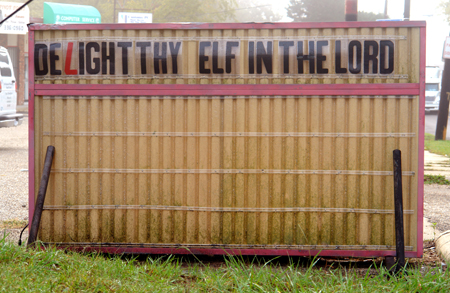
Highland Road, Baton Rouge, early this morning. I didn’t touch it, I promise!
good as gold
“As good as gold.”
—Charles Dickens, from A Christmas Carol, 1843.
Sun-treader
“Sun-treader, life and light be thine forever!”
—Robert Browning, from Pauline, 1833. He is referring to the poet Shelley.
the purple light of Love
“O’er her warm cheek and rising bosom move
The bloom of young Desire and the purple light of Love.”
—Thomas Gray, from The Progress of Poesy, 1754.
deeper than the green sea’s glass
“Eyes colored like a water-flower,
And deeper than the green sea’s glass;”
—Algernon Charles Swinburne, from F’lise, 1866.
to see feelings
“Perhaps one of the most difficult things to convey to a mind not in the hasheesh delirium . . . is the interchange of senses. . . . [T]he hasheesh-eater knows what it is . . . to smell colors, to see sounds, and, much more frequently, to see feelings. How often do I remember vibrating in the air over a floor bristling with red-hot needles, and, although I never supposed I came in contact with them, feeling the sensation of their frightful pungency through sight as distinctly as if they were entering my heart.”
—Fitz Hugh Ludlow, from The Hasheesh Eater, 1857.