a sight King James specially liked to look upon
“Here and there burnt vast bonfires of cedar and oak wood, lavishly salted, so that the flames were of green, orange, and purple fire. But however fiercely they burnt, the heat was not enough to melt the ice which, though of singular transparency, was yet of the hardness of steel. So clear indeed was it that there could be seen, congealed at a depth of several feet, here a porpoise, there a flounder. Shoals of eels lay motionless in a trance, but whether their state was one of death or merely of suspended animation which the warmth would revive puzzled the philosophers. Near London Bridge, where the river had frozen to a depth of some twenty fathoms, a wrecked wherry boat was plainly visible, lying on the bed of the river where it had sunk last autumn, overladen with apples. The old bumboat woman, who was carrying her fruit to market on the Surrey side, sat there in her plaids and farthingales with her lap full of apples, for all the world as if she were about to serve a customer, though a certain blueness about the lips hinted the truth. ’Twas a sight King James specially liked to look upon, and he would bring a troupe of courtiers to gaze with him. In short, nothing could exceed the brilliancy and gaiety of the scene by day. But it was at night that the carnival was at its merriest. For the frost continued unbroken; the nights were of perfect stillness; the moon and stars blazed with the hard fixity of diamonds, and to the fine music of flute and trumpet the courtiers danced.”
—Virginia Wolfe, a specially brilliant passage from Orlando, 1928.
oyster-coloured velvet
“The person, whatever the name or sex, was about middle height, very slenderly fashioned, and dressed entirely in oyster-coloured velvet, trimmed with some unfamiliar greenish-coloured fur.”
—Virginia Wolfe, from Orlando, 1928.
a lamp lit within
“[H]alting at length, out of breath, she said, panting slightly, that he was like a million-candled Christmas tree (such as they have in Russia) hung with yellow globes; incandescent; enough to light a whole street by; (so one might translate it) for what with his glowing cheeks, his dark curls, his black and crimson cloak, he looked as if he were burning with his own radiance, from a lamp lit within.”
—Virginia Wolfe, from Orlando, 1928.
brown earth and blue blood
“He held that the mixture of brown earth and blue blood was a good one.”
—Virginia Wolfe, from Orlando, 1928.
green in literature
“He was describing, as all young poets are for ever describing, nature, and in order to match the shade of green precisely he looked (and here he showed more audacity than most) at the thing itself, which happened to be a laurel bush growing beneath the window. After that, of course, he could write no more. Green in nature is one thing, green in literature another. . . . The shade of green Orlando now saw spoilt his rhyme and split his metre.”
—Virginia Wolfe, from Orlando, 1928.
color itself
“I do believe [San Francisco mural painter Hilaire] Hiller knows more about color than any man alive. He eats and drinks color. Himself he’s the color of color. He’s not just colorful, as we say of certain gay and charming birds, but he’s color itself. That means that he refracts light extraordinarily well. Sometimes he becomes a veritable aurora borealis.”
—Henry Miller, from The Air-Conditioned Nightmare, 1945.
the morning of the day after the night before
“A little beyond looms the face of the beloved. Ever larger, ever fuller, ever clearer it grows: a moon-glow that saturates an empty sky. Slowly, slow as claustral fever, the nebulae arrive. Little medallions constellate the panic that clouds the orifices of fright. Intaglio depths gleam from the precipitious walls of new world hearts. Through the laughing mouth oceans leap in to being and pain still-born is cried down again. The marvels of emptiness parade their defilement, the embryonic unsheath their splendor. Echolalia mounts her throne. The web stretches tighter, the ravisher is ravished. A slat gives way, an axe falls; little children drop like flowers on the burnished hearth beneath the open door. It is the morning of the day after the night before on the threshold of unsubjugated repetition. It fits like a silver-studded bracelet on a warm wrist.”
—Henry Miller, from The Air-Conditioned Nightmare, 1945.
Linds and Lu
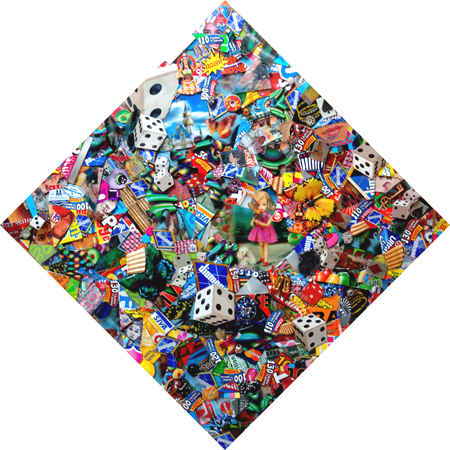
Linds and Lu, collage by Paul Dean, 2006. Lu is Lindsay’s favorite poodle, Lulu.
stochastic resonance
“Put a crayfish in a silent aqaurium, add a turtle and it gets eaten, but add some random background noise to simulate the crackling and popping we can hear on underwater recordings made with hydrophones and the crayfish escapes. This is called stochastic resonance. Aural white noise or visual white noise can help both humans and crayfish to distinguish the event they want to see or hear. The randomness of white noise allows more possiblilites of a very faint sound wave finding another wave with which it can resonate and so be reinforced.”
—David Toop, from Haunted Weather: Music, Silence and Memory, 2004.
the tiniest of holes
“I sat at my desk in the office staring down at the white tablet. It was more or less flying-saucer-shaped, a streamlined disk with the tiniest of holes at one end. It was only after moments of intense scrutiny that I’d been able to spot the hole.”
—Don DeLillo, from White Noise, 1985.