Butterflies
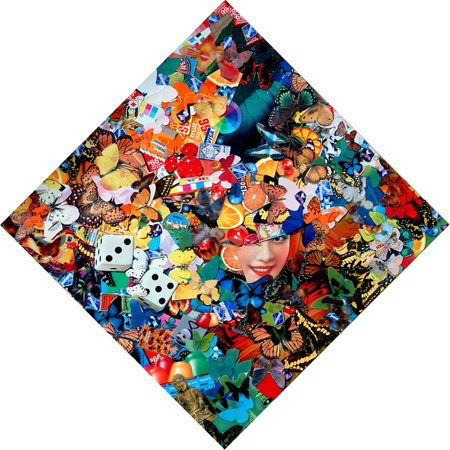
Butterflies, a collage by Paul Dean, 2006. The newest piece in the exhibition Diamond Cutter, now showing at the Baton Rouge Gallery.
in their dialect, evil was literally called good
“So corrupt was their most ordinary language . . . that, in their dialect, evil was literally called good, and good, evil—the well-disposed man was branded wicked, whilst the leader in monstrous vice was styled virtuous.”
—William Ullathorne, a Catholic priest, on the convict society he encounted on Norfolk Island in the early 1800s; quoted by Robert Hughes in The Fatal Shore: The Epic of Australia’s Founding, 1987.
Tejo Remy’s Chest of Drawers
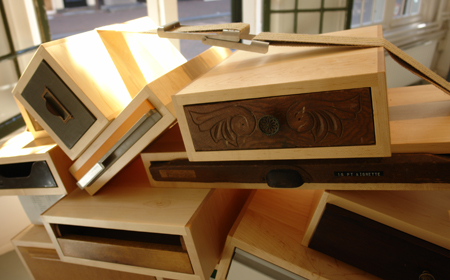
Tejo Remy’s Chest of Drawers (detail), 1991; used drawers, maple. At the Droog store, Amsterdam. Photo by Paul Dean.
Tasmanian bushrangers
“[T]he Tasmanian bushrangers began as convict kangaroo hunters who stayed out in the bush and formed gangs. . . .
They had long ratty hair, thick beards, roughly sewn garments and moccasins of kangaroo hide, a pistol stuck in a rope belt, a stolen musket, a polecat’s stench. When on raids, they blacked their faces with charcoal. Most of them would kill a man as soon as a kangaroo. Some joked about this.”
—Robert Hughes, The Fatal Shore: The Epic of Australia’s Founding, 1987.
star-glazers.
[T]hose who cut the panes out of shopwindows.
—Henry Mayhew, from an analysis of the London underworld in London Labor and the London Poor, 1862; quoted by Robert Hughes in The Fatal Shore: The Epic of Australia’s Founding, 1987.
snow gatherers.
[T]hose who steal clean clothes off the hedges.
—Henry Mayhew, from an analysis of the London underworld in London Labor and the London Poor, 1862; quoted by Robert Hughes in The Fatal Shore: The Epic of Australia’s Founding, 1987.
The black-spice racket
“The black-spice racket consisted of stealing bags of soot from sweeps. . . .”
—Robert Hughes, The Fatal Shore: The Epic of Australia’s Founding, 1987.
a purple dromedary
“O all the myriad kinds of thief [in 19th century London] . . . the most dextrous were the files and buzz-gloaks, or pickpockets. . . . A pupil with no talent for this was scorned as a purple dromedary.”
—Robert Hughes, The Fatal Shore: The Epic of Australia’s Founding, 1987.
his red shirt
“Even 25 lashes (known as a tester . . . ) was a draconic torture, able to skin a man’s back and leave it a tangled web of criss-crossed knotted scars. . . .
The scarred back became an emblem of rank. So did silence. Convicts called a man who blubbered and screamed at the triangles a crawler or a sandstone. (Sandstone is a common rock around Sydney; it is soft and crumbles easily.) By contrast, the convict who stood up to it in silence was admired as a pebble or an iron man. He would show his shapes (strip for punishment) with disdain, and after the domino (last lash) he would spit at the feet of the man who gave him his red shirt. There were always more sandstones than pebbles.”
—Robert Hughes, The Fatal Shore: The Epic of Australia’s Founding, 1987.
a dark cloud
“And always, everywhere on the expanding limits of settlement, the Aborigine was seen as a mere native pest, like a dingo or kangaroo. He was a myall, a murky, a boong or (in a phrase that precisely expressed the whites’ belief in his inevitable passing) a dark cloud.”
—Robert Hughes, The Fatal Shore: The Epic of Australia’s Founding, 1987.