a mantle of royal purple, crowned with a diadem of gold
“On the long, slow journey across northern France [King Henry V] was represented by a lifelike effigy made of boiled leather, clothed in a mantle of royal purple, crowned with a diadem of gold and precious stones, holding the royal sceptre in one hand and the golden cross and ball in the other. This effigy was laid on a bed on the top of the chariot carrying the coffin and was sufficiently raised to make the royal figure easily visible to all the onlookers. The illusion of a living king’s formal entry was re-enacted at each town on the slow journey to Rouen and north to Calais. . . .”
—Margaret Wade Labarge, Medieval Travellers: The Rich and Restless, 1982.
‘Guernica’
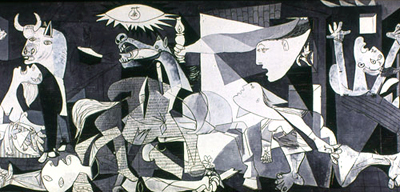
“Picasso’s smartest decision in “Guernica,” a consummate feat of pictorial intelligence, was to limit its palette to black-and-white. He thereby . . . [implied] that war is no time for indulgence and, by evoking the look of a newspaper, factored in the modern experience of comprehending catastrophe (and of inflicting it) at a distance.”
—Peter Schjeldahl, Spanish Lessons: Picasso in Madrid, The New Yorker, June 19, 2006.
a single three-dimensional drawing poised in space
“It was not until the early eighteen-thirties that the English scientist and inventor Charles Wheatstone began to suspect that the disparities between the two retinal images were . . . crucial to the brain’s mysterious ability to generate a sensation of depth—and that the brain somehow fused these images automatically and unconsciously.
Wheatstone confirmed the truth of his conjecture by an experimental method as simple as it was brilliant. He made pairs of drawings of a solid object as seen from the slightly different perspectives of the two eyes, and then designed an instrument that used mirrors to insure that each eye saw only its own drawing. He called it a stereoscope, from the Greek for ‘solid vision.’ If one looked into the stereoscope, the two flat drawings would fuse to produce a single three-dimensional drawing poised in space.”
—Oliver Sachs, Stereo Sue: Why Two Eyes are Better than One, The New Yorker, June 19, 2006.
a dream-like exaltation
“The shutting out of surrounding objects, and the concentration of the whole attention . . . produces a dream-like exaltation . . . in which we seem to leave the body behind us and sail into one strange scene after another, like disembodied spirits.”
—Oliver Wendell Holmes, describing the photographic stereo viewer experience in 1861. Quoted by Oliver Sachs in Stereo Sue: Why Two Eyes are Better than One, The New Yorker, June 19, 2006.
startling stereoscopic relief
“Gazing at wallpaper with small repetitive motifs, [David Brewster] observed [as early as 1844] that the patterns might quiver or shift, and then jump into startling stereoscopic relief, especially if these patterns were offset in relation to one another. Such “autostereograms” have probably been experienced for millennia. . . . Medieval manuscripts such as the Book of Kells or the Lindisfarne Gospels, for example, contain exquisitely intricate designs done so exactingly that whole pages can be seen, with the unaided eye, as stereoscopic illusions. (John Cisne, a paleobiologist at Cornell, has suggested that such stereograms may have been “something of a trade secret among the educated elite of the seventh and eighth century British Isles.”)”
—Oliver Sachs, Stereo Sue: Why Two Eyes are Better than One, The New Yorker, June 19, 2006.
conventionalized representations of concrete objects
“Writing, according to the latest theories, was invented in southern Mesopotamia for the first and perhaps the only time. The oldest written texts come from Uruk toward the end of the fourth millennium B.C. They were impressed on clay tablets with a reed stylus and then baked. The signs, though linear in form, are no longer purely pictographic, as in some of the preliterate drawings on clay, but considerably conventionalized representations of concrete objects. The new invention must have quickly proved its worth, for it apparently provided the stimlus to the beginning of pictographic writing in Egypt and Persia . . . by about 3000 [B.C.].”
—William W. Hallo & William Kelly Simpson, The Ancient Near East: A History, 1971.
Mesopotamian graphics
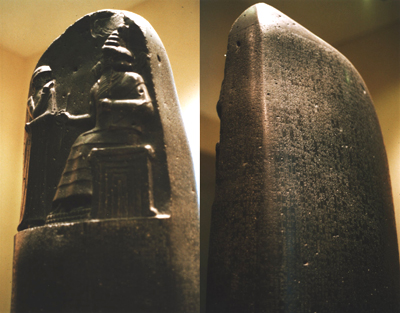
“[Hammurabi’s] most famous remains are the somewhat overinterpreted and perhaps misnamed Code of Hammurabi. Originally, it was an eight-foot-high black basalt stele erected at the end of his reign beside a statue or possibly idol of himself. So far as we can make out, someone seeking redress from another would come to the steward’s statue, to “hear my words” (as the stele says at the bottom), and then move over to the stele itself, where the previous judgments of the stewards god are recorded. . . . [T]he top of the stele is sculptured to depict the scene of judgment-giving. The god is seated on a raised mound which in Mesopotamian graphics symbolizes a mountain. An aura of flames flashes up from his shoulders as he speaks (which has made some scholars think it is Shamash, the sun-god). Hammurabi listens intently as he stands just below him (“under-stands”). The god holds in his right hand the attributes of power, the rod and circle very common to such divine depictions. Whith these symbols, the god is just touching the left elbow of his steward, Hammurabi. One of the magnificent things about this scene is the hypnotic assurance with which both god and steward-king intently stare at each other, impassively majestic, the steward-king’s right hand held up between us, the observers, and the plane of communication. Here is no humility, no begging before a god, as occurs just a few centuries later. . . . There is only obedience. And what is being dictated . . . are judgments on a series of very specific cases.”
—Julian Jaynes, from The Origin of Consciousness in the Breakdown of the Bicameral Mind, 1976. That last bit reminds me of the Dog Whisperer. Does anybody know what I mean?
Atrium
Central room in Roman house, often open to sky.
—Chester G. Starr, The Ancient Romans, 1971.
Codex.
A parchment volume bound like a modern book, as opposed to a papyrus roll.
—Chester G. Starr, The Ancient Romans, 1971.
Moloch.
Sacrifice especially of first-born sons in Phoenician religion. (Not a god, as often defined.)
—Chester G. Starr, The Ancient Romans, 1971.