imaginary architecture
“The illusionism of the architectural framework in which it is set is characteristic of painting in Italy at [the Hellenistic and Roman] period. Ambitious—spatial and not flat—decorative schemes appeared early in the first century BC, visually enlarging the space of rooms with columns, entablatures and other architectural elements. . . . Later, a further step was taken by visually opening the wall, sometimes completely, sometimes with make-believe windows, to disclose vistas of colonnades stretching into the far distance. In the first century AD this imaginary architecture was treated with increasing fantasy to conjure up buildings of a more insubstantial elegance than any that could be erected on earth. . . .
These various types of painting are usually categorized as the Pompeiian Syles I, II, III and IV . . . [because] by far the largest number of examples have survived there. One room in the house of evidently prosperous merchants combines all four illusionistic systems or styles—a dado of simulated panels of rare marbles; pictures hung on or set in the wall and surrounded by frames which seem to project forwards; windows opening on to views of airy structures; and, above, statues placed on top of the wall, beyond which fanciful buildings may be glimpsed in space.”
—Hugh Honour & John Fleming, from The Visual Arts: A History, 1982.
Isral Duke
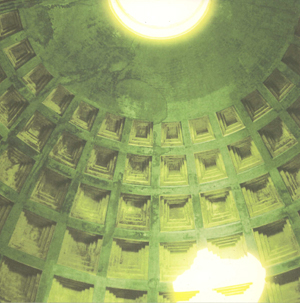
Graphic design by Isral Duke, from a graphic design course called Color. Isral earned an “A” for his careful cropping and the compelling expressionistic color treatment of this piece, created from a black-and-white half-tone of the interior of the Parthenon.
The Pantheon
“The Pantheon was built under Trajan’s successor, the Emperor Hadrian (AD 117–138), on the site of an earlier temple, which had been of an entirely different design but similarly dedicated to all the gods. . . . One passes from a world of hard confining angular forms into one of spherical infinity, which seems almost to have been created by the column of light pouring through the circular eye or oculus of the dome and slowly, yet perceptibly, moving round the building with the diurnal motion of the earth. . . .
The interior is substantially intact. The various types of marble, mainly imported from the eastern Mediterranean and used for the pattern of squares and circles on the pavement, for the columns and the sheathing of the walls—white veined with blue and purple (pavonazzo), yellowish-orange (giallo antico), porphyry and so on—still reflect and colour the light which fills the whole building.”
—Hugh Honour & John Fleming, from The Visual Arts: A History, 1982.
Trajan’s Column
“If triumphal arches were conceived as historical statements, so, too, were the tall commemorative columns set up in Rome—another and even more peculiar Roman invention than the triumphal arch. The first was Trajan’s Column, entirely covered by a marble band of figurative carving winding up its shaft and originaly topped by a gilded statue of the emperor (replaced in 1588 by a statue of St Peter). It commemorated his campaigns in Dacia (present-day Romania) in AD 101 and 105–6, the main events of which are depicted in chronological sequence from bottom to top. As the column originally stood between two libraries founded by Trajan, it has been suggested that the cylindrical helix of the carving was inspired by the scrolls on which all books were then written. To read this figurative history from end to end, however, was not as simple a matter as unrolling a parchment scroll. The reader must walk round the column no less than 23 times with eyes straining ever further upwards! The scale increases slightly towards the top, but the upper registers are hard to see and impossible to appreciate and must always have been so, even when the figures were picked out in bright colors and gilding.”
—Hugh Honour & John Fleming, from The Visual Arts: A History, 1982. Everybody’s a critic.
the Book of Kells
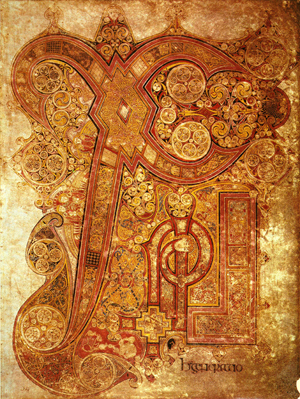
Incarnation Initial from the Book of Kells, early 9th century.
the very shrine of art
“Examine it carefully and you will penetrate to the very shrine of art. You will make out intricacies so delicate and subtle, so concise and compact, so full of knots and lines, with colours so fresh and vivid, that you might think all this was the work of an angel, not a man.”
—Giraldus de Barri, twelfth century, on one of the great Celtic manuscripts, perhaps the Book of Kells.
Harper’s Bazaar
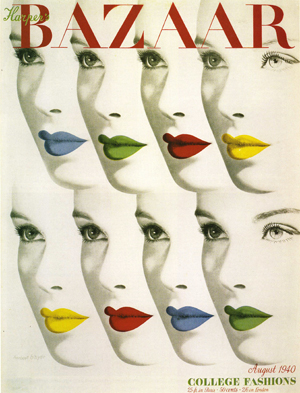
Cover design by Herbert Bayer, 1940.
“total design”
“[Herbert] Bayer perhaps best exemplified the principles promoted by the Bauhaus, especially its core concept that good design by itself could improve the human condition. Bayer fervently believed and enthusiastically promoted this idea despite all evidence to the contrary in Nazi Germany at that time. Also, throughout his long career, Bayer espoused the key Bauhaus goal of unifying all the arts into a single expression that he called “total design.” Though best known as a graphic designer who created everything from signage to letterheads, Bayer also produced paintings, photographs, sculptures, earthworks, site plans and buildings.”
—Michael Paglia, from Herbert Bayer: Beyond the Bauhaus, an article in Modernism magazine, Summer 2005.
lower case letters
“In 1925, shortly after [Walter] Gropius asked him to head up the graphics and typography workshop at the Dessau Bauhaus, [Herbert] Bayer designed his universal type, a simplified sans-serif design limited to lower case letters. Bayer convinced Gropius to use only lower case letters for all Bauhaus communications, from magazines to signage to invitations. In fact, Bayer would use only lower case letters for the rest of his life, including for the titles of all his future art works.”
—Michael Paglia, from Herbert Bayer: Beyond the Bauhaus, an article in Modernism magazine, Summer 2005.
mound with ring of water
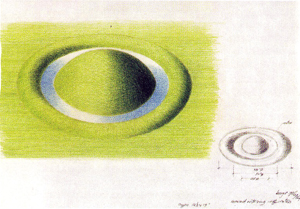
Sketch for a proposed mound with ring of water, Herbert Bayer, 1956.