the red rose
“He held the rose by its long, hardy stem, and swept it lightly and
caressingly across her forehead, along her cheek, and over her pretty
mouth and chin, as a lover might have done with his lips. He noticed
how the red rose left a crimson stain behind it.”
—Kate Chopin, ‘In and Out of Old Natchitoches’, from Bayou Folk, 1894.
ultimate beauty
“You know how it is. A three-hundred dollar suit doesn’t knock your eye
out. A Ming vase doesn’t shriek for attention. But the ultimate beauty,
the perfection, is there; and you’ll always see it if you look long
enough, see it and recognize it, regardless of whether you’ve ever seen
it before.
Even if you’ve caught so much crap in your eyes that
you’re half-blind in one and can’t see out of the other . . .”
—Jim Thompson, WIld Town, 1957. The ellipses are his.
putting words down on paper
“‘Oh, now, really, Mr. McKenna,’ the operator laughed. ‘I’ll bet that’s your secret ambition, isn’t it? To be a writer?’
‘Well,’ Bugs shrugged easily, ‘why not? Nothing much
to it that I can see, once you’ve got a plot. Just putting words down
on paper.’
‘Now, that’s true, isn’t it? If you’ve got a good
idea, why, anyone could make a good story out of it. It certainly can’t
take any brains to do that.’”
—Jim Thompson, WIld Town, 1957.
A River Runs Through It: An American Tragedy
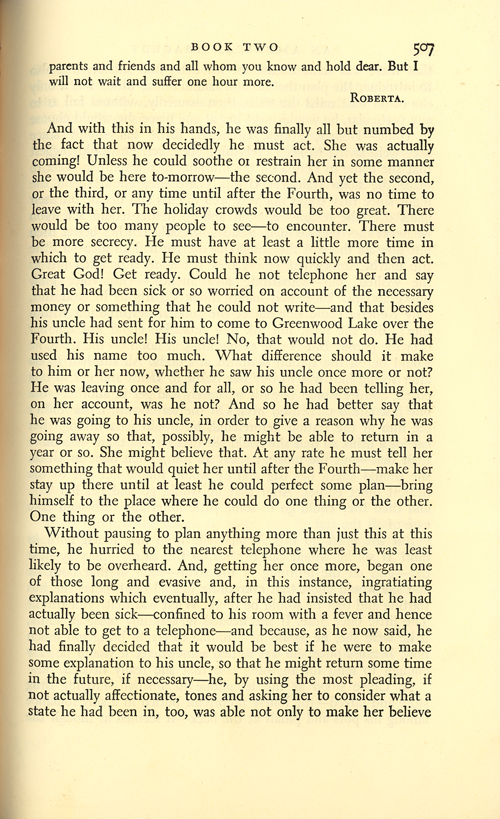
cuts like a knife into the first full paragraph on page 507 of Theodore
Dreiser’s An American Tragedy, The World Publishing Company, 1948 edition.
(A river runs through it. Don’t you get it?
Its a typographic river. A white column of gaps in the text. This marks
the third in a continuing series of typographic rivers in literature.
The other two are here and here.)
An American Tragedy
So . . . this summer I’ve been reading books from this list of the top 100 English-language novels since 1923, many of which I had
never read, or even heard of before. Last night I finished An American Tragedy
by Theodore Dreiser, all 874 pages of it. Yes, I read it all. OK . . . I may
have skimmed a few paragraphs of courtroom drama, but still, I finished
it! My review? Uh . . . I would say it was interesting and ahead of its
time. I will call it a powerful and insightful social satire. A few good color quotes (see below). A
must to read if you’re trying to read everything on a list of the top
100 English-language novels since 1923.
pinkly carpeted
“[I]n the orchard of a spring day later, between her fourteenth and
eighteenth years when the early May sun was making pink lamps of every
aged tree and the ground was pinkly carpeted with the falling and
odorous petals, she would stand and breathe and sometimes laugh, or
even sigh, her arms upreached or thrown wide to life. To be alive! To
have youth and the world before one.”
—Theodore Dreiser, An American Tragedy, 1925.
an airy, fairy quality
“But canoeing fascinated him really. He was pleased by the picturesque
and summery appearance he made in an outing shirt and canvas shoes
paddling about Crum Lake in one of the bright red or green or blue
canoes that were leased by the hour. And at such times these summer
scenes appeared to possess an airy, fairy quality, especially with a
summer cloud or two hanging high above in the blue.”
—Theodore Dreiser, An American Tragedy, 1925.
a huge, black pearl
“The insidious beauty of this place! Truly, it seemed to mock him—this
strangeness—this dark pool, surrounded on all sides by those wonderful,
soft, fir trees. And the water itself looking like a huge, black pearl
cast by some mighty hand, in anger possibly, in sport or phantasy
maybe, into the bottom of this valley of dark, green plush—and which
seemed bottomless as he gazed into it. . . .
And again he lowered his head and gazed into the fascinating and yet
treacherous depths of that magnetic, bluish, purple pool, which, as he
continued to gaze, seemed to change its form kaleidoscopically to a
large, crystalline ball. But what was that moving about in this
crystal? A form! It came nearer—clearer—and as it did so, he recognized
Roberta struggling and waving her thin white arms out of the water and
reaching toward him! God! How terrible! The expression on ther face!
What in God’s name was he thinking of anyway? Death! Murder!”
—Theodore Dreiser, An American Tragedy, 1925.
though your sins be as scarlet
“‘I bring you, Clyde, the mercy and the salvation of your God. He has
called on me and I have come. He has sent me that I may say unto you
though your sins be as scarlet, they shall be white—like snow. Though
they be red, like crimson, they shall be as wool. Come now, let us
reason together with the Lord.’”
—Theodore Dreiser, An American Tragedy, 1925.
transparent color
“The relation of light to transparent color is, when you come to look
into it deeply, infinitely fascinating, and when the colors flare up,
merge into one another, arise anew, and vanish, it is like taking
breath in great pauses from one eternity to the next, from the greatest
light down to the solitary and eternal silence in the deepest shades.
The opaque colors, in contrast, are like flowers that do not dare to
compete with the sky. . . . It is is these, however, that are able . .
. to produce such pleasing variations and such natural effects that . .
. ultimately the transparent colors end up as no more than spirits
playing above them and serve only to enhance them.”
—Johann Wolfgang von Goethe, from the ‘Supplement’ to his Farbenlehre
[Theory of Color], quoted by Walter Benjamin in ‘A Glimpse Into the
World of Children’s Books’, 1926, translated by Rodney Livingstone;
from The Work of Art in the Age of its Technological Reproducibility and Other Writings on Media, 2008.