It is night
“It is night now, no longer evening but fully night, as in “black as,” if not precisely “dead of.” Evening usually has the afternoon hanging on its coattails, has actual flecks of daylight clinging like lint to its lapels, but night is solitary, aloof, uncompromised, extreme. The safe margins of the day, still faintly visible during eventide, have been erased by night’s dense gum, obscured by its wash of squid squirtings, pajama sauce, and the blue honey manufactured by moths. Is the night a mask, or is day merely night’s prim diguise? Most of us are born in the night, and by night most will die. Night, when tangos play on the nurse’s radio and rat poison sings its own hot song behind the cellar door. Night, when the long snake feed, when the black sedan cruises the pleasure districts, when neon flickers “Free at Last” in a dozen lost languages, and shapes left over from childhood move furtively behind the moon-dizzy boughs of the fir.”
—Tom Robbins, Half Asleep in Frog Pajamas, 1994.
a twenty-dollar gold piece
“Oh, when I die, please bury me
In my ten dollar Stetson hat;
Put a twenty-dollar gold piece on my watch chain
So my friends’ll know I died standing pat.”
—St. James Infirmary Blues, traditional American folksong, famously covered by Louis Armstrong, Cab Calloway, and many many more.
going to Kansas City
“Don’t hang your head when you see those six pretty horses pullin’ me.
Put a twenty-dollar silver piece on my watch chain,
Look at the smile on my face,
And sing a little song to let the world know I’m really free.
Don’t cry for me, ’cause I’m going to Kansas City.”
—Parker’s Mood, by King Pleasure, 1954; this popular song was a vocalized transcription of a Charlie Parker saxophone solo. Charlie Parker hated this song. Quoted by Ross Russell in Bird Lives! The High Life & Hard Times of Charlie (Yardbird) Parker, 1973.
The Shadow
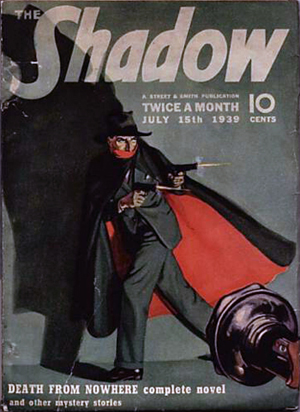
“Who knows what evil lurks in the hearts of men? The Shadow knows.”
—the opening line of The Shadow, the radio play, heard regularly from the 1930s through the early 1950s.
a new linguistics
“The new underground required a new linguistics. To “broom” meant to travel by air. . . . Money was gold. Eyes meant willingness or enthusiasm. A pad was a bed, therefore someone’s room or apartment. . . . Out of the world became gone. . . . Blow your top became flip your wig, leading to flipped, flipped out, wigged, wig, and wiggy. Knocked out yielded gassed, as in an old-fashioned dentist’s chair. The verb gas gave the noun gas, a delighful experience. . . . Cool and dig served as verbs, adverbs, adjectives, and nouns. . . .
Pod, more commontly pot, first appeared to describe cannabis, standard drug since jazz began in New Orleans, heir to a lengthy list of names: hay, golden leaf, cool green, gage, muggles, [and] mezzirolls (after Chicago jazzman Milton Mezzrow). . . .”
—Ross Russell, from Bird Lives! The High Life & Hard Times of Charlie (Yardbird) Parker, 1973.
the cats at Sunshine
“‘When Fate deals you one from the bottom of the deck, fall by the Sunshine Funeral Parlors. Your loved ones will be handled with dignity and care, and the cats at Sunshine will not lay too heavy a tab on you.’”
—Symphony Sid, “radio’s Mister Hip,” broadcasting from Birdland in the late 1940s; quoted by Ross Russell in Bird Lives! The High Life & Hard Times of Charlie (Yardbird) Parker, 1973.
The word bebop
“The word bebop was thought to be onomatopoetic in origin, like klook-a-mop, and in fact may have been drived from the latter. Others said it had been invented by the jivey, irrepressible Fats Waller. Nobody liked it much, least of all the new jazzmen. But it stuck.”
—Ross Russell, a footnote from Bird Lives! The High Life & Hard Times of Charlie (Yardbird) Parker, 1973.
klook-a-mop
“To lead the house band at Minton’s [Playhouse] Teddy Hill hired the very man he had fired less than a year before. Kenny “Klook” Clarke. . . . “Klook,” Clarke’s nickname, had arisen from the onomato-poetic klook-a-mop, a kind of double bomb, one of Clarke’s favorite percussion figures. . . . Now . . . Teddy Hill though about the bombs, the jagged zigzaggy rhythms that somehow worked, and . . . offered him the contract. . . .”
—Ross Russell, from Bird Lives! The High Life & Hard Times of Charlie (Yardbird) Parker, 1973.
‘woodshedding’
“Charlie’s practice sessions, or “woodshedding,” as it was called by jazzmen, took place at home. He rose early in the afternoon, around one o’clock. . . . After breakfast Charlie went upstairs to his room and drew the green shade of the window that looked out over the gardens and clotheslines of the Olive Street neighborhood. Then he removed his horn from its case and began to practice.”
—Ross Russell, from Bird Lives! The High Life & Hard Times of Charlie (Yardbird) Parker, 1973.
a blazing ring of light
“When he got to the corner he could . . . see the cluster of electric signs at Twelfth and Paseo. The electric signs formed a blazing ring of light; everything down there looked almost like it did in the daytime.
The signs were made of coiled neon tubing, which had just come into that part of Kansas City. Some of the newer night clubs had them. The rest had old-fashioned displays with small electric light bulbs spelling out the letters. On some of the signs an arrow of light chased itself around the border. Others flashed off and on. On some of the neon signs the colors flickered and changed from pale blue to the color of orange soda water. There was a big sign over the Sunset Club and another over the Boulevard Lounge, and farther along you saw signs advertising the Lone Star and the Cherry Blossom.”
—Ross Russell, from Bird Lives! The High Life & Hard Times of Charlie (Yardbird) Parker, 1973.