This is the look
“[Jos’ Ortega y Gasset] labels one look ‘the most effective, the most suggestive, the most delicious and enchanting.’ He called it the most complicated because it is not only furtive, but it is also the very opposite of furtive, because it makes it obvious that it is looking. This is the look given with lidded eyes, the sleepy look or calculating look or appraising look, the look a painter gives his canvas as he steps back from it. . . .
Describing this look, Ortega said the lids are almost three-quarters closed and it appears to be hiding itself, but in fact the lids compress the look and ‘shoot it like an arrow.’
‘It is the look of eyes that are, as it were, asleep but which behind the cloud of sweet drowsiness are utterly awake. Anyone who has such a look possesses a treasure.’
Ortega said that Paris throws itself at the feet of anyone with this look. . . . Robert Mitchum certainly had it and it set him up for years as a masculine sex symbol. Mae West copied it and the French actress Simone Signoret has it. . . .”
—Julius Fast, Body Language, 1970.
Saint Patrick’s Breastplate
“I arise today
Through the strength of heaven:
Light of sun,
Radiance of moon,
Splendor of fire,
Speed of lightning,
Swiftness of wind,
Depth of sea,
Stability of earth,
Firmness of rock.”
—from Saint Patrick’s Breastplate, a prayer possibly but not definitely written by Saint Patrick (387–493 C.E.). Quoted by Thomas Cahill in How the Irish Saved Civilization: The Untold Story of Ireland’s Heroic Role from the Fall of Rome to the Rise of Medieval Europe, 1995.
like shining from shook foil
“The world is charged with the grandeur of God.
It will flame out, like shining from shook foil”
—Gerard Manley Hopkins, as quoted by Thomas Cahill in How the Irish Saved Civilization: The Untold Story of Ireland’s Heroic Role from the Fall of Rome to the Rise of Medieval Europe, 1995.
the shape of the modern book
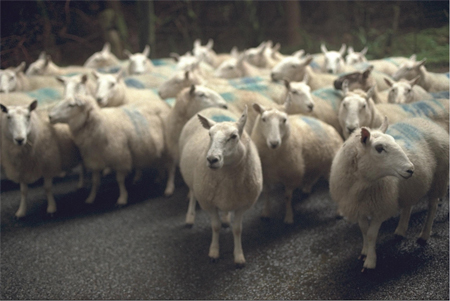
“The pages of most books were of mottled parchment, that is, dried sheepskin, which was . . . nowhere more abundant than in Ireland, whose bright green fields still host each April an explosion of new white lambs. Vellum, or calfskin, which was more uniformly white when dried, was used . . . sparingly for the most honored texts. . . . It is interesting to consider that the shape of the modern book, taller than wide, was determined by the dimensions of a sheepskin, which could most economically be cut into double pages that yield our modern book shape when folded.”
—Thomas Cahill, How the Irish Saved Civilization: The Untold Story of Ireland’s Heroic Role from the Fall of Rome to the Rise of Medieval Europe, 1995.
the Irish codex
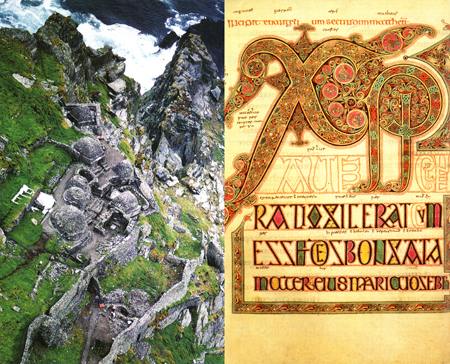
A seventh-century monastery on Skellig Michael, off the Irish coast, and a page from the Book of Kells.
“At the outset there were in Ireland no scriptoria to speak of, just individual hermits and monks, each in his little beehive cell or sitting outside in fine weather, copying a needed text from a borrowed book, old book on one knee, fresh sheepskin pages on the other. . . . [T]hey found the shapes of letters magical. Why, they asked themselves, did a B look the way it did? Could it look some other way? . . . The result of such why-is-the-sky-blue questions was a new kind of book, the Irish codex; and one after another, Ireland began to produce the most spectacular, magical books the world has ever seen.”
—Thomas Cahill, How the Irish Saved Civilization: The Untold Story of Ireland’s Heroic Role from the Fall of Rome to the Rise of Medieval Europe, 1995.
the white Gospel page, shining
“[The scribal scholars of Ireland] did not see themselves as drones. Rather, they engaged the text they were working on, tried to comprehend it after their fashion, and, if possible, add to it, even improve on it. In this dazzling new culture, a book was not an isolated document on a dusty shelf; book truly spoke to book, and writer to scribe, and scribe to reader, from one generation to the next. . . .
In a land where literacy had previously been unknown, in a world where the old literate civilizations were sinking fast beneath successive waves of barbarism, the white Gospel page, shining in all the little oratories of Ireland, acted as a pledge: the lonely darkness had been turned into light, and the lonely virtue of courage, sustained through all the centuries, had been transformed into hope.”
—Thomas Cahill, How the Irish Saved Civilization: The Untold Story of Ireland’s Heroic Role from the Fall of Rome to the Rise of Medieval Europe, 1995.
“The hand that wrote this is no more”
“Sad it is, little parti-colored white book, for a day will surely come when someone will say over your page: ‘The hand that wrote this is no more.’”
—Anonymous, from a manuscript quoted in How the Irish Saved Civilization: The Untold Story of Ireland’s Heroic Role from the Fall of Rome to the Rise of Medieval Europe, by Thomas Cahill, 1995.
serious play
“At its beginnings, the New Orleans Mardi Gras was based on the French Catholic pre-Lenten festivity calendar. It was celebrated in public at first by white men who appeared in blackface and strangely reenacted some of the moves that celebrated the bringing together of slaves from different plantations in the late seventeenth and eighteenth centuries after the crops had been harvested. . . . This was a time of serious play, deep play, in which all the resources of the community were called on in an amazing bonfire blast that could easily be interpreted as a riot.”
—Roger D. Abrahams, Blues for New Orleans: Mardis Gras and America’s Creole Soul, 2006.
images of “wildness”
“The Zulu parade of New Orleans’ black middle class and elite community, founded n 1909 as a reaction to white stereotypes of blacks as “savages,” is a Carnival activity rivaled in scope and visibility only by the Rex parade on Mardi Gras day. Zulu members dress in Mardi Grass skirts and “wooly wigs,” put on blackface, and throw rubber spears and decorated coconuts to the delighted crowds. Working class blacks . . . also invoke images of ‘wildness’ by masquerading proudly in sylized Plains Indians costumes.
The black “Mardi Gras Indians” are hierarchical groups of men with titles such as Big Chief, Spyboy, Wildman, and Lil’ Chief who dress in elaborate bead and feather costumes weighing up to a hundred pounds. The best-known costume makers say that their costume patterns come to them in dreams, and they take pride in never repeating a color or theme from year to year. After months of time and money invested in sewing costumes and practice sessions at local bars, a dozen or more “tribes” appear early on Mardis Gras day to sing, dance, and parade through back street neighborhoods.”
—Roger D. Abrahams, Blues for New Orleans: Mardis Gras and America’s Creole Soul, 2006.
The umbrella’s use in New Orleans parades
“Umbrellas, both furled and unfurled, are seen in the Mardis Gras and jazz funeral marches of New Orleans, in Brazil, in the brushback dance of Trinidad, and again among the cakewalk dancers in the United States in the nineteenth and eartly twentieth centures. Ribbons are attached to the top of the open umbrellas, and feathered birds are used as finials, much as among the Asante people of Southern Ghana and elsewhere in Africa. The umbrella’s use in New Orleans parades is symbolic, rhythmic, and practical in serving as parasols against the blistering sun. These highly decorated umbrellas are not used in the rain, however. . . .”
—Roger D. Abrahams, Blues for New Orleans: Mardis Gras and America’s Creole Soul, 2006.