the endless Negro blocks
“he walked the endless Negro blocks to home because it was still day. He was suspicious of them by night or by day. What were they forever laughing about from doorstep to door that he could never clearly hear—Their voices dropped when he came near and didn’t rise till he was past earshot. Yet their prophecies pursued him—
De Lord Give Noah de rainbow sign—
Wont be by water but by fire next time”
—Nelson Algren, from A Walk on the Wild Side, 1956. As quoted in Sustaining New Orleans: Literature, Local Memory, and the Fate of a City by Barbara Eckstein, 2006.
Rising Sun Blues
“There is a house in New Orleans
They call the Rising Sun
It’s been the ruin of many poor girls,
And me, O Lord, for one. . . .
One foot is one the platform,
The other one on the train,
I’m going back to New Orleans
To wear that ball and chain.”
—Rising Sun Blues, traditional, first recorded by bluesman Texas Alexander in 1928. Most commonly sung by men, including Bob Dylan and Eric Burden (of the Animals), the song is, ironically, a Storyville prostitute’s lament. As quoted (and explained) in Sustaining New Orleans: Literature, Local Memory, and the Fate of a City by Barbara Eckstein, 2006.
lines tend to want words
“Use number 2 pencils. Get a good pencil sharpener and sharpen about twenty pencils. When one is dull, grab another. . . .
Write in a hard-covered notebook with green lined pages. Green is easy on the eyes. Blank white paper seems to challenge you to create the world before you start writing. It may be true that you, the modern poet, must make the world as you go, but why be reminded of it before you even have one word on the page? The lines tend to want words. Blank paper begs to be left alone. The best notebooks I’ve found are National 43-581.”
—Richard Hugo, The Triggering Town: Lectures and Essays on Poetry and Writing, 1979.
the green wall
“Be glad of the green wall
You climbed across one day,
When winter stung with ice
That vacant paradise.”
—James Wright, quoted by Richard Hugo in The Triggering Town: Lectures and Essays on Poetry and Writing, 1979.
the transport of the Countess Mahaut
“The arrangements for the transport of the Countess Mahaut [of Artois]’s household were in the accepted pattern. Since her usual retinue was only made up of some forty people it . . . probably only required some sixty horses . . . [with] many highly decorated saddles . . . worked in silk velvet with flowers of gold, others with pearls. Not surprisingly leather covers were provided for the safe transport of such precious objects. . . . [S]he made much use of a large four-wheeled chariot. . . . Not only was it provided when necessary with new wheels, well shod with iron, but there might also be a new cover of tan cloth, lined on the inside with samite. The interior was adorned with velvet curtains sprinkled with silver rosettes, striped hangings of perse (a fine, usually dark blue, woollen cloth), with the chains and rings to hang them, a carpet of seven and a half ells, and eighteen decorative silver knobs. . . . As Mahaut grew older she relied more and more on another litter. The one she used in 1321 was covered in scarlet, had a well-stuffed mattress with three cushions and two pillows covered with luxurious silk, striped with gold and silver, and filled with down. Its horses had saddle pads of velvet and housings of azure perse. For access there was a folding stool and a small ladder.”
—Margaret Wade Labarge, Medieval Travellers: The Rich and Restless, 1982.
a mantle of royal purple, crowned with a diadem of gold
“On the long, slow journey across northern France [King Henry V] was represented by a lifelike effigy made of boiled leather, clothed in a mantle of royal purple, crowned with a diadem of gold and precious stones, holding the royal sceptre in one hand and the golden cross and ball in the other. This effigy was laid on a bed on the top of the chariot carrying the coffin and was sufficiently raised to make the royal figure easily visible to all the onlookers. The illusion of a living king’s formal entry was re-enacted at each town on the slow journey to Rouen and north to Calais. . . .”
—Margaret Wade Labarge, Medieval Travellers: The Rich and Restless, 1982.
‘Guernica’
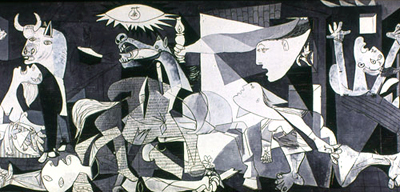
“Picasso’s smartest decision in “Guernica,” a consummate feat of pictorial intelligence, was to limit its palette to black-and-white. He thereby . . . [implied] that war is no time for indulgence and, by evoking the look of a newspaper, factored in the modern experience of comprehending catastrophe (and of inflicting it) at a distance.”
—Peter Schjeldahl, Spanish Lessons: Picasso in Madrid, The New Yorker, June 19, 2006.
a single three-dimensional drawing poised in space
“It was not until the early eighteen-thirties that the English scientist and inventor Charles Wheatstone began to suspect that the disparities between the two retinal images were . . . crucial to the brain’s mysterious ability to generate a sensation of depth—and that the brain somehow fused these images automatically and unconsciously.
Wheatstone confirmed the truth of his conjecture by an experimental method as simple as it was brilliant. He made pairs of drawings of a solid object as seen from the slightly different perspectives of the two eyes, and then designed an instrument that used mirrors to insure that each eye saw only its own drawing. He called it a stereoscope, from the Greek for ‘solid vision.’ If one looked into the stereoscope, the two flat drawings would fuse to produce a single three-dimensional drawing poised in space.”
—Oliver Sachs, Stereo Sue: Why Two Eyes are Better than One, The New Yorker, June 19, 2006.
a dream-like exaltation
“The shutting out of surrounding objects, and the concentration of the whole attention . . . produces a dream-like exaltation . . . in which we seem to leave the body behind us and sail into one strange scene after another, like disembodied spirits.”
—Oliver Wendell Holmes, describing the photographic stereo viewer experience in 1861. Quoted by Oliver Sachs in Stereo Sue: Why Two Eyes are Better than One, The New Yorker, June 19, 2006.
startling stereoscopic relief
“Gazing at wallpaper with small repetitive motifs, [David Brewster] observed [as early as 1844] that the patterns might quiver or shift, and then jump into startling stereoscopic relief, especially if these patterns were offset in relation to one another. Such “autostereograms” have probably been experienced for millennia. . . . Medieval manuscripts such as the Book of Kells or the Lindisfarne Gospels, for example, contain exquisitely intricate designs done so exactingly that whole pages can be seen, with the unaided eye, as stereoscopic illusions. (John Cisne, a paleobiologist at Cornell, has suggested that such stereograms may have been “something of a trade secret among the educated elite of the seventh and eighth century British Isles.”)”
—Oliver Sachs, Stereo Sue: Why Two Eyes are Better than One, The New Yorker, June 19, 2006.