A Chorale* of Cherokee Night Music As Heard through an Open Window In Summer Long Ago
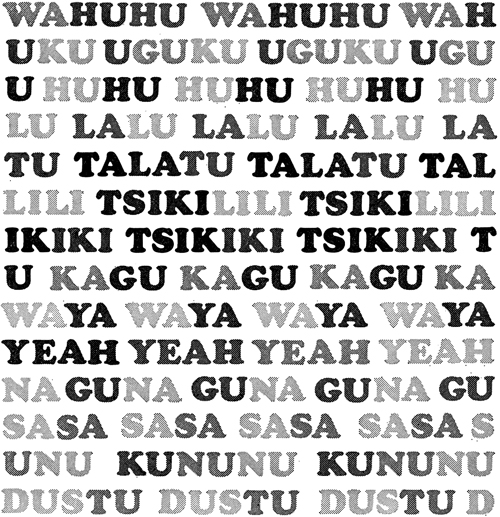
carolina chickadee / katydid / crow / wolf / Beatles / turkey / goose /
bullfrog / spring frog
—Jonathan Williams, from Blues Roots & Rue Bluets; A Garland for the Southern Appalachians, 1985.
A flat toothpick
“A box of . . . Ideal toothpicks from the mid-1960s carries on its bottom this telegraphic legend: ‘The only Toothpick tapered thin—polished—removes food particles from between closely set teeth.’ A flat toothpick bought today is likely to have been stamped out of veneer that has not first been beveled or skived. The result is a thin little stick with blunt ends that hardly deserves the name toothpick. It is typically very ineffective for fine picking, though it may still serve for chewing.”
—Henry Petroski, The Toothpick; Technology and Culture, 2007.
Diamond quality
“A box of Diamond Brand ‘double pointed-tapered-flat polished white birch’ toothpicks from abou the 1960s claimed to contain ‘the most perfect toothpick made.’ The toothpick’s quality . . . was touted on every panel, including the bottom, which bragged that the product was ‘made in U.S.A. by American workers of American materials.’ The bottom of the box said also of the Diamond trademark on the top that ‘its use on a package of wood products insures Diamond quality of both materials and workmanship—Every One Perfect.’”
—Henry Petroski, The Toothpick; Technology and Culture, 2007.
three million toothpicks
“With or without promotions by the industry, adults have developed hobbies, if not obsessions, involving the construction out of toothpicks and glue of replicas of everything from a crucified Christ to the Titanic and other historic steamships. . . . The Christ, which was made up of 65,000 sandwich, flat, square, and round toothpicks, took 2,500 hours of work to glue into place. The rock guitarist Wayne Kusy used 194,000 toothpicks to make a sixteen-foot-long replica of the Lusitania. . . .
Stephen Backman, who took two and a half years to craft a thirteen-foot replica of the Golden Gate Bridge out of thirty thousand toothpicks, describes himself as an ‘artist working in toothpicks.’. . . Another sculptor, Michael A. Smith, of Baton Rouge, Louisiana, produced a fifteen-foot-long, 850-pound alligator by gluing together about three million toothpicks, which took him about three years.”
—Henry Petroski, The Toothpick; Technology and Culture, 2007.
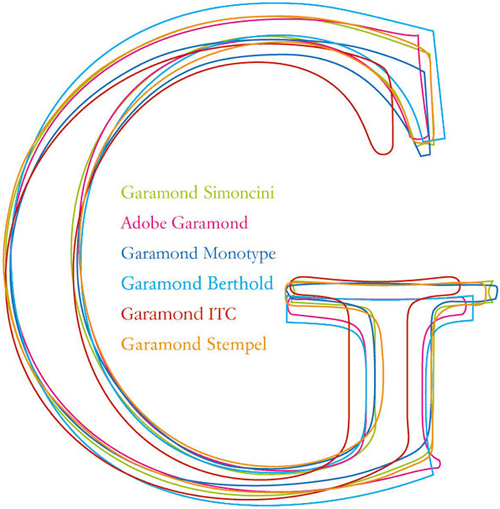
Garamond v Garamond
a mill for making paper
“The invention of paper is credited to Ts’ai Lun, a Chinese, in the early years of the second century. . . .
It took a thousand years for Ts’ai Lun’s idea to reach Europe. In the interval paper was produced in Japan, early in the seventeenth century. In the eighth it appeared in Samarkand; the process is though to have been picked up by Arabs from Chinese prisoners. The Moors may have carried paper-making into Europe. The year 1085 is given as the date of a mill for making paper at Jativa, Spain, that produced a rag sheet, chiefly of linen fibers.”
–Warren Chappell, A Short History of the Printed Word, 1970.
variations on a theme
“One logical and rewarding way [to consider roman type] is to think of the forms as a series of geometrical variations on a theme of square, circle, and triangle, which, when set together, will become a frieze of contracting and expanding spatial interruptions. This breathing quality is the very essence of the inscriptional concept, and is responsible for the liveliness as well as the nobility of the great classic carvings. Almost every letter shape carries its contained space, which in type is called the counter, and which is related, in composition, to the separations between letters. This inner space is not only vital to the color of a form—its black-and-white value—but is also an integral part of it.”
—Warren Chappell, A Short History of the Printed Word, 1970.
A serif
“A serif is a terminal device, functionally employed to strengthen lines which otherwise would tend to fall away optically. This is especially true of incised lines. By using a chisel in such a way that the finishing cuts were wider, a craftsman produced a strong terminal with a bracketed appearance.”
—Warren Chappell, A Short History of the Printed Word, 1970.
Roman [type]
“Roman [type] has come to be divided into three categories. Those having calligraphic stress and bracketed serifs are old style. Romain du roi was the forerunner of the types called transitional. The third category, modern, is applied to those alphabets, starting with Bodoni’s in 1790, which have lost all relationship to written models.”
–Warren Chappell, A Short History of the Printed Word, 1970.
stereotype
“As early as 1727, William Ged, of Edinburgh, invented a means of pressing a type form into material that could then be used as a matrix to make a casting duplicating the form. Ged’s invention was strongly opposed by the printers of his time, but in 1794, Firmin Didot became interested in the machine and experimented with the inventions of Ged and others. It was Didot who gave the process its name: stereotype, the prefix ‘stereo’ describing the solidity of the printing unit.”
—Warren Chappell, A Short History of the Printed Word, 1970.