K
“I find the letter K offensive, almost nauseating.”
—Franz Kafka, in his diary; quoted by David Sacks in Letter Perfect, 2003.
M
“The emblem of the Hell’s Angels, termed ‘colors,’ consists of an embroidered patch of a winged skull wearing a motorcycle helmet. Just below the wings of the emblem are the letters ‘MC.’ Over this is a band bearing the words ‘Hell’s Angels.’. . .
Another patch worn by some members bears the number ‘13.’ It is reported to represent the thirteenth letter of the alphabet, ‘M,’ which in turn stands for marijuana and indicates the wearer thereof is a user of the drug.”
—Hunter S. Thompson, Hell’s Angels, 1967.
Vowels for Wales
“My wife and I were driving around England once, and we came to a section called ‘Wales,’ which is this linguistically deformed area that apparently is too poor to afford vowels. All the road signs look like this:
It is a tragic sight indeed to see Welsh parents attempting to sing traditional songs such as ‘Old MacDonald Had a Farm’ to their children and lapsing into heart-rending silence when they get to the part about ‘E-I-E-I-O.’ If any of you in our reading audience have extra vowels that you no longer need, because for example your children have grown up, I urge you to send them (your children) to: Vowels for Wales, c/o Lord Chesterfield, Parliament Luckystrike, the Duke of Earl, Pondwater-on-Gabardine, England.”
—Dave Barry, Europe on Five Vowels a Day, from Dave Barry’s Greatest HIts, 1988.
famous letters and numbers
“Although it was constructed in 1536, the New York subway system boasts an annual maintenance budget of nearly $8, currently stolen, and it does a remarkable job of getting New Yorkers from point A to an indeterminate location somewhere in the tunnel leading to point B. It’s also very easy for the ‘out-of-towner’ to use, thanks to the logical, easy-to-understand system of naming trains after famous letters and numbers. For directions, all you have to do is peer up through the steaming gloom at the informative signs, which look like this:
EXPRESS LOCAL ONLY LL 67 ♦
DDD 4♠ 1K ✩ AAAA 9 ONLY
EXCEPT CERTAIN DAYS BB ®® 3
MIDWAY THROUGH TOWN 1 7 D
WALK REAL FAST AAAAAAAAA 56
‘YY’ ♣ 1,539
AAAAAAAAAAAAAAAAAA”
—Dave Barry, Can New York Save Itself?, from Dave Barry’s Greatest HIts, 1988.
an entirely new concept
“This year we, of course, have an entirely new concept. We have been working on it for just months and months now, and we are extremely proud of it, because it is so highly innovative. Are you ready? Here it is:
Gray.
Eveybody got that? Better write it down! If we find any ladies out on the street without their gray on, we are going to be very upset. Also we are asking you to purchase certain mandatory accessories in the form of several thousand dollars worth of handbags, shoes, belts, and watch straps made from dead crocodiles. NO, YOU MAY NOT ASK WHY! JUST DO IT!”
—Dave Barry, Revenge of the Pork Person, from Dave Barry’s Greatest HIts, 1988.
I am the urn of Tita Vendia
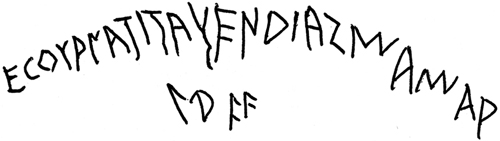
—David Sacks, Letter Perfect, 2003.
The most beautiful lettering in the world
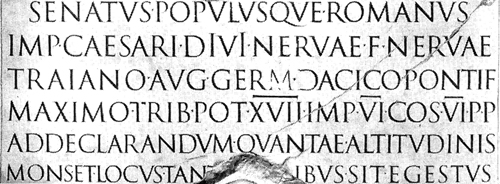
“The most beautiful lettering in the world is often said to be found in
this marble-carved inscription of A.D. 113, which survives, although
damaged, on the large pedestal of Trajan’s Column in Rome.”
—David Sacks, Letter Perfect, 2003.
[T]he medieval i
“[T]he medieval i originally had no dot but acquired one because the letter as a hatless stroke was hard to distinguish on a crowded page of handwriting. By about A.D. 1000 the custom had arisen of perhaps topping the minuscule letter with a slanted mark, at the writer’s discretion: ´. With the spread of printing in the late 1400s, the stroke was generally reduced to an economical dot i . . . although the stroke still shows up today in cursive-print wedding invitations and similar. The i’s dot, meanwhile, has become proverbial for any small detail. . . .”
—David Sacks, Letter Perfect, 2003.
Iesus Nazarenus
“At Jesus’ execution, the Roman letters INRI formed the initials of a
sarcastic Latin title: Iesus Nazarenus Rex Iudaeorum, ‘Jesus of Nazareth, King of the
Jews.’. . .
Julius Caesar was actually named Iulius (Yoolius). The emperor Trajan was Traianus (Trah-yahn-us). . . . Whatever future claim the letter J might have on these words in English, they began in Latin with rather different sounds and spellings. . . .”
—David Sacks, Letter Perfect, 2003.
IVLIVS CAESAR and MARCVS AVRELIVS
“Back when Julius Caesar or Marcus Aurelius ruled Rome, U’s shape was sharper, more svelte. In fact U looked exactly like her future daughter V (without V’s sound). Thus, in Roman stone-carved inscriptions, the above-mentioned emperors’ names would appear as IVLIVS CAESAR and MARCVS AVRELIVS.”
—David Sacks, Letter Perfect, 2003.