still waters
like ingots of gold
“Having learned late in life, Tom was but a slow reader, and passed on laboriously from verse to verse. Fortunate for him was it that the book he was intent on was one which slow reading cannot injure—nay, one whose words, like ingots of gold, seem often to need to be weighed separately, that the mind may take in their priceless value.”
—Harriet Beecher Stowe, Uncle Tom’s Cabin, 1852.
GET A DUNE BUGGY
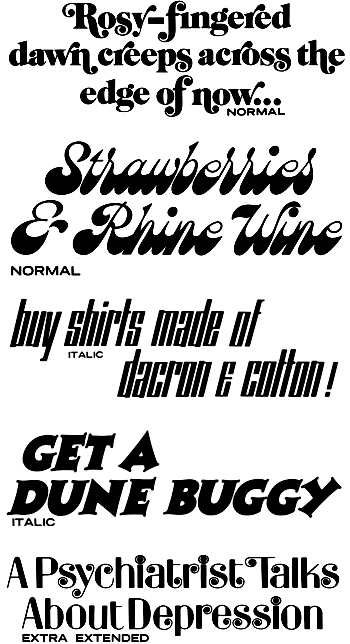
Some more type specimens from the 1969 LetterGraphics catalog of the previous post. The typefaces are Arriola Caslon Swash, Brandywine, Stein Long, Charlie Pointed, and, Spring. I particularly like the use of Spring in the faux-headline about depression. It’s a hopeful touch. I recognize a lot of the fonts in this catalog ffrom greeting cards; 1969 must have been a watershed year for greeting cards. If you consider that in 1969 Rod McKuen (available now in every thirft store) was by far America’s best-selling poet, it all starts to make a kind of crazy sense.
Young America does swing
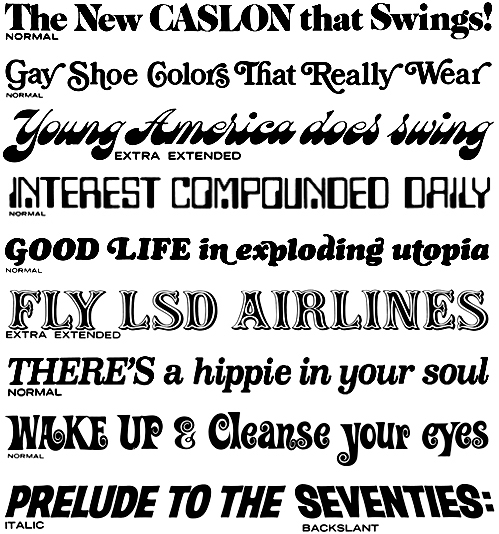
It’s the end of the semester, and on monday I ran into a pile of old books that were up for grabs before going into the trash. Imagine my astonishment as I opened a plain black three-ring binder and discovered New LetterGraphics Styles 1969, a type catalog from LetterGraphics of Culver City, California. It was disheveled and out of order, but I was looking at type specimens from 1969! Rock and roll!!!
Here, purely for your enjoyment, are some representative specimens. The fonts, from top to bottom, are Arriola Caslon, Bookman Bold Swash, Brandywine, Data Process, Cooper Italic Swash, Flair Lined Caps, Oxford Italic, Holiday and Manhattan.
a bang and a squiggle
“Victor Borge . . . suggests that conversation could be improved with audible punctuation—with pops, hisses, whistles, clicks, ticks, crackles, bangs and squiggles audibly punctuating our everyday speech! But as his act ends and the applause and laughter fade away you begin to realize that Borge . . . made a good point when he followed the sentence ‘Was I an idiot’ with a bang and a squiggle. . . . How often have we felt that need!? Or when the query is of greater stress than the emphasis, why not reverse the signals?!”
—Edward Rondthaler, Life with Letters, as they turned photogenic, 1981.
Art in letter form
“Art in letter form begins where geometry ends.”
—Paul Standard; quoted by Edward Rondthaler in Life with Letters, as they turned photogenic, 1981.
Anybody can draw one letter
“Anybody can draw one letter; some people can draw two; but it takes a real designer to draw three.”
—Harry Payne; quoted by Edward Rondthaler in Life with Letters, as they turned photogenic, 1981.
All must be in tune
“I look for unevenness, for letters that are over- or under-weight, for any inconsistencies that might flag the flavor. Every letter must be independently legible so that if it is seen out of context it will not be misread. Finally the entire alphabet must be ‘in tune.’. . .
The oboe is the first instrument you hear when a symphony orchestra begins to ‘tune up.’ The oboe gives the pitch. It has great penetration and can easily be heard by all the other instruments. Now comes a surprising coincidence: the letters O B E in the word OBOE and the lowercase letters o b e —or preferably o d e —are, by the nature of their design, key letters that give the pitch to which other letters of the alphabet may be tuned. O B E and o d e carry a big load in determining the character of a style. They are not dramatic shapes like a or g or s, but they sound the pitch clearly. First they must be in tune with each other, then the remaining letters should be in design harmony or in artistic balance with these three. All must be in tune.”
—Edward Rondthaler, Life with Letters, as they turned photogenic, 1981.
[I]f the alphabet is your hobby
“[I]f the alphabet is your hobby you’re in the best company of all: Aristotle, Plato, Shakespeare, Gutenberg, King James, Samuel Johnson, Ben Franklin, Thomas Jefferson, A. Lincoln, Ernest Hemingway, Hermann Zapf, Eugene Ettenberg, Norman Cousins, Tom Wicker, Winston Churchill, and Franklin Roosevelt too—all of them and many other greats have shown their expertise in using the alphabet superbly.”
—Edward Rondthaler, Life with Letters, as they turned photogenic, 1981.
she lived too Fast
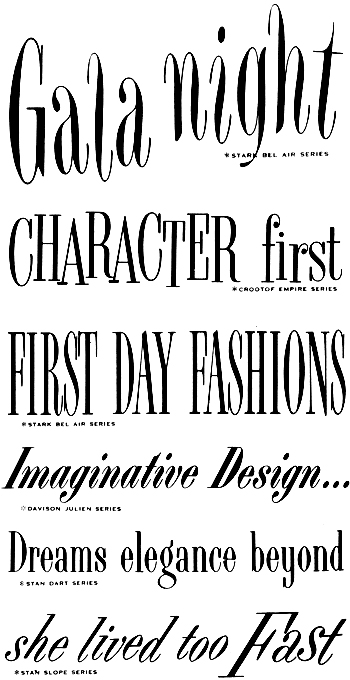
Please enjoy for a few moments the luxurious lettering of a time
gone by. . . . I noticed while I was assembling the previous post that
my selections
tended towards the cleaner, more ‘progressive’ international style that
would come to prominence in the United States in the 1960s. This bolder
and squarer
modern style is actually rather scarce in the catalog, which, in
general, fairly revels in the flair for frippery that the ’50s are
famous for. So here’s a second helping of specimens from the same
1955 Photo-Lettering catalog.