her dingat
“Right away Antoine pushed the fat mama down on her knees . . . He was awfully brutal . . . She had her ass up in the air . . . He tickled and teased her . . . He couldn’t find her dingat . . . He tore her ruffles . . . he tore everything in sight . . .”
—Louis-Ferdinand Céline, Death on the Installment Plan, translated by Ralph Manheim, 1966.
every imaginable color
“The bathers crowd around, all hysterical . . . The raging sea pounds me down to the bottom, then lifts me gasping to the surface . . . In a flashing moment I see that they’re discussing my agony . . . There they are, every imaginable color: green . . . blue, parasols, lavender ones, lemon-yellow ones . . . I whirl about in pieces . . . And then I don’t see a thing . . .”
—Louis-Ferdinand Céline, Death on the Installment Plan, translated by Ralph Manheim, 1966.
[T]he universe that we know
“[T]he universe that we know is immensely large and complex. Its extension in time and space is beyond human scale and comprehension. The universe is 15 billion years old; our sun is 4.5 billion years old. In contrast, our human species appeared only 130,000 years ago and the first cave paintings only 35,000–50,000 years ago. The numbers alone enforce both a sense of perspective and humility. Humbling, too, is the knowledge that we are intimately connected with the universe ‘all the way up and all the way down,’ because we know that chemically and biologically we share a common ancestry with both the stars and the simplest life forms.”
—Dennis Ford, The Search for Meaning: A Short History, 2007.
the principle of alphabetic writing
“[T]rue alphabetic writing consists in having a sign for each sound (technically each phoneme) of the language, rather than one for each word or one for each syllable. This is the most efficient writing system possible, since a language will be found to have some thousands of words and at least a couple of hundred different syllables, but the words and syllables are made up of individual speech sounds which seldom exceed sixty to seventy in number, and sometimes number as few as a dozen. Hence an alphabetic writing system can, with the fewest possible units . . . record every possible utterance in the language.”
—John P. Hughes, The Science of Language, 1962.
Old Semitic
”[A]s far as can be ascertained from the available records, the
principle of alphabetic writing has only been discovered once—hence, in
the whole world there is only one alphabet. . . . [A]ny people which
writes in alphabetic signs has learned and adapted the use of the
alphabet from another people who, in turn, had done the same. . . .
The earliest preserved inscriptions in alphabetic script date to about 1725 B.C. and were found in and around Byblos, in the country then known as Phoenicia (now Lebanon). It would seem that an alphabetic script which we might call Old Semitic was fairly familiar in that region at that time. . . .
This Old Semitic alphabet is of course the ancestor of the Hebrew, Phoenician, and Aramaic systems of writing. From these northern Semites, the knowledge of the alphabet appears to have passed, on the one hand, to the Greeks of Asia Minor, and on the other, to the Brahmans of ancient India, who developed from it their devanagari, the sacred script in which the religious rituals and hymns of the ancient Hindus were recorded.”
—John P. Hughes, The Science of Language, 1962.
a dome of blending tints
“The sky too has its changes. . . . Clouds map it up at times, but it is normally a dome of blending tints, and the main tint blue. By day the blue will pale down into white where it touches the white of the land, after sunset it has a new circumference—orange, melting upwards into tenderest purple. But the core of blue persists, and so it is by night. Then the stars hang like lamps from the immense vault.”
—E.M. Forster, A Passage to India, 1924.
A little green bird
“A little green bird was observing her, so brilliant and neat that it might have hopped straight out of a shop. On catching her eye it closed its own, gave a small skip and prepared to go to bed. Some Indian wild bird. . . .
‘Do you know what the name of that green bird up above us is?’ she asked, putting her shoulder rather nearer to his.
‘Bee-eater.’
‘Oh no, Ronny, it has red bars on its wings.’
‘Parrot,’ he hazarded.
‘Good gracious no.’
The bird in question dived into the dome of the tree. It was of no importance, yet they would have liked to identify it, it would somehow have solaced their hearts. But nothing in India is identifiable, the mere asking of a question causes it to disappear or to merge in something else.”
—E.M. Forster, A Passage to India, 1924.
the colour of their skins
“When they argued about it something racial intruded—not bitterly, but inevitably, like the colour of their skins: coffee-colour versus pinko-grey.”
—E.M. Forster, A Passage to India, 1924.
the height of impropriety
“The remark that did him the most harm at the club was a silly aside to the effect that the so-called white races are really pinko-grey. He only said this to be cheery, he did not realize that ‘white’ has no more to do with a colour than ‘God save the King’ with a god, and that it is the height of impropriety to consider what it does connote. The pinko-grey male whom he addressed was subtly scandalized; his sense of insecurity was awoken, and he communicated it to the rest of the herd.”
—E.M. Forster, A Passage to India, 1924.
my collection
My art. Not the art that I’ve created, but the art that I own. Art that I liked enough to pay for. Well . . . one of these was a gift, one them was purchased at art market prices, and the other purchased at a thrift store. I”m a thrift shopper . . . but the point is, this is all art that I like. Art is experience, not a market commodity. So, take a deep breath. Relax. And please enjoy a few paintings from my collection.
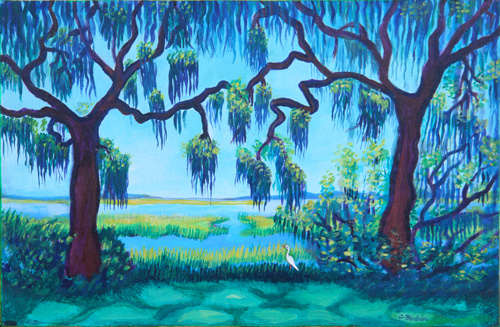 Charles Barbier, Marsh, 2005.
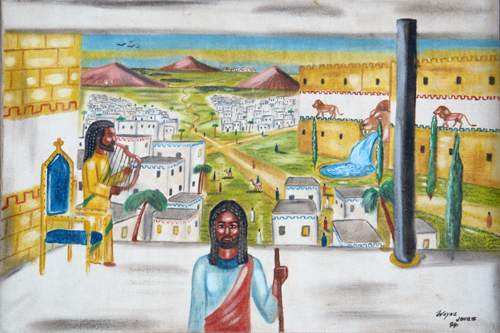 Wayne Jones, Untitled, 1994.
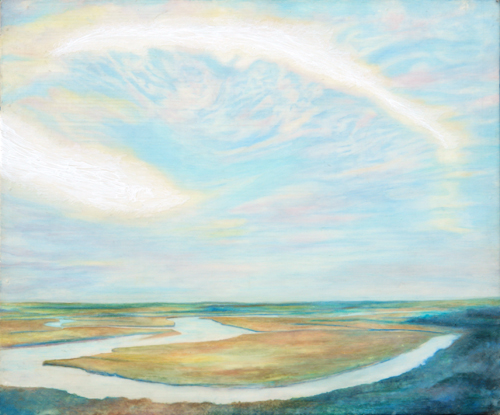
Jim Kellough, Old Bald Head, 2001.