Phoebe.
Phoebus.
In later mythology Apollo had the epithet Phoebus, meaning “light” or “bright,” and was often identified with the sun god Helios.
—Classical Gods and Heroes, translated and edited by Rhoda A. Hendricks, 1974.
this rare sight

“Known in the weather world as a circumhorizontal arc, this rare sight was caught on film on June 3 as it hung over northern Idaho near the Washington State border.
The arc isn’t a rainbow in the traditional sense—it is caused by light passing through wispy, high-altitude cirrus clouds. The sight occurs only when the sun is very high in the sky (more than 58′ above the horizon). What’s more, the hexagonal ice crystals that make up cirrus clouds must be shaped like thick plates with their faces parallel to the ground.
When light enters through a vertical side face of such an ice crystal and leaves from the bottom face, it refracts, or bends, in the same way that light passes through a prism. If a cirrus’s crystals are aligned just right, the whole cloud lights up in a spectrum of colors.
This particular arc spanned several hundred square miles of sky and lasted for about an hour. . . .”
—Victoria Gilman for National Geographic, June 19, 2006.
black mud
“[They s]end bubbles to the surface of this ooze
As glancing roundabouts you may observe.
Fixed in the slime they say: ‘Sullen we were
In the sweet air cheered by the brightening sun
Because of sulky vapors in our hearts;
Now here in this black mud we curse our luck.’
This burden, though they cannot form in words,
They gurgle in their gullets”
—Dante Alighieri, The divine comedy, translated by Thomas G. Bergin, 1969.
Night Thoughts
“This is creation’s melancholy vault,
The vale funereal, the sad cypress gloom;
The land of apparitions, empty shades!
All, all on earth is shadow. . . .
This is the bud of being, this dim dawn,
The twilight of our day, the vestibule.”
—Edward Young, from Night Thoughts, 1741.
He would close his eyes
“Belacqua made a long arm and switched off the lamp. It threw shadows. He would close his eyes, he would bilk the dawn in that way. What were the eyes, anyway? The posterns of the mind. They were safer closed.”
—Samuel Beckett, from Yellow, the penultimate story in More pricks than kicks, 1970.
a gleam and shimmering
“I see at the confines of this restless gloom a gleam and shimmering as of bones.”
—Samuel Beckett, from The Beckett Trilogy: Malone, Malloy dies, The Unnamable, 1979.
all stirring
“the eyes stare into the space before them, namely the fulness of the great deep with its unchanging calm. . . . But at long intervals they close. . . . Perhaps it is then he sees the heaven of the old dream, the heaven of the sea and of the earth too, and the spasms of the waves from shore to shore all stirring to their tiniest stir. . . .”
—Samuel Beckett, from The Beckett Trilogy: Malone, Malloy dies, The Unnamable, 1979.
Light of a kind
“One night as he sat at his table head on hands he saw himself rise and go. One night or day. For when his own light went out he was not left in the dark. Light of a kind came then from the one window.”
—Samuel Beckett, As the story was told: uncollected and later prose, edited by John Calder, 1990.
$135 million
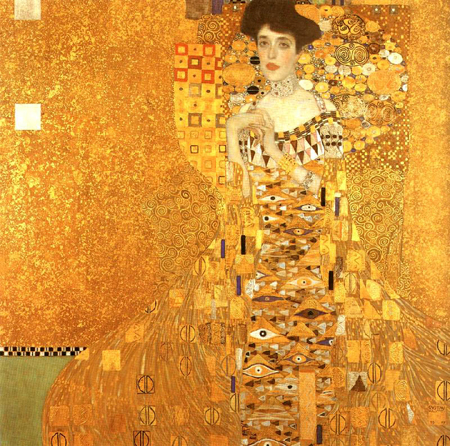
“A dazzling gold-flecked 1907 portrait by Gustav Klimt has been purchased for the Neue Galerie in Manhattan by the cosmetics magnate Ronald S. Lauder for $135 million, the highest sum ever paid for a painting.
The portrait, of Adele Bloch-Bauer, the wife of a Jewish sugar industrialist and the hostess of a prominent Vienna salon, is considered one of the artist’s masterpieces.”
The New York Times, just today. I say why not and right on!