those colors that we call red, orange, yellow, and maroon
“in the Philippines there is a group of people called the Hanunoo. They divide all colors into just four—mabiru, malagiti, marara, and malatuy. Marara, for example, includes those colors that we call red, orange, yellow, and maroon. If you show a Hanunoo man a red shirt and a yellow shirt he will tell you that they are both marara. If you press him he might add that the first is “more marara” or the second “weak marara,” but they will both remain as marara.”
—E. Fuller Torrey, The Mind Game: Witchdoctors and Psychiatrists, 1972.
a handful of palm nuts
“Divination is [a] technique commonly used by therapists, especially in Africa, to impress their patients. Nigerian babalawos, for instance, do not take a history from their patients. Rather a patient whispers his problem to a handful of palm nuts; the babalawo then casts the nuts and from their position makes a diagnosis.
Other methods of divination include throwing “bones” (wooden blocks with markings), feeling the patient’s pulse, constant gazing at water, star-gazing, watching the flickering of an oil lamp, listening to the wind, and watching the trembling of the hands. It should be emphasized that these procedures, frequently ridiculed in Western descriptions . . . are methods used by the therapist to increase his reputation and, thus, increase the patient’s faith and expectations. Often the therapist is in possession of accessory information that allows him to make an accurate dianosis.”
—E. Fuller Torrey, The Mind Game: Witchdoctors and Psychiatrists, 1972.
the evil eye
“Mal ojo, the evil eye, is commonly used [by Mexican-Americans] to explain psychiatric symptoms. It is caused when a person with “strong vision” admiringly or enviously looks at another. . . . Its causation is usually assumed to be inadvertent and the person is not held consciously responsible; implicit, however, is responsibility for unconscious desires. . . .
Clinically mal ojo occurs more often in the younger age groups. Headaches, crying, irritability, and restlessness are common symptoms. . . . Traditional treatments include prayers and “sweeping” or “cleansing” the patient with a raw egg. Another approach to treatment is to try and locate the person who inadvertently caused it (usually within the preceding 24 hours); if this person simply touches the afflicted the illness will be cured.”
—E. Fuller Torrey, The Mind Game: Witchdoctors and Psychiatrists, 1972.
eye management
“Simply, eye management in our society boils down to two facts. One, we do not stare at another human being. Two, staring is reserved for a non-person. We stare at art, at sculpture, at scenery. We go to the zoo and stare at the animals, the lions, the monkeys, the gorillas. We stare at them for as long as we please, as intimately as we please, but we do not stare at humans if we want to accord them human treatment. . . .
With unfamiliar human beings, when we acknowledge their humanness, we must avoid staring at them, and yet we must also avoid ignoring them. To make them into people rather than objects, we use a deliberate and polite inattention. We look at them long enough to make it quite clear that we see them, and then we immediately look away. We are saying, in body language, ‘I know you are there,’ and a moment later we add, ‘But I would not dream of intruding on your privacy.’. . .
If we wish to put a person down we may do so by staring longer than is acceptably polite. Instead of dropping our gazes when we lock glances, we continue to stare. The person who disapproves of interracial marriage or dating will stare rudely at the interracial couple. If he dislikes long hair, short dresses or beards he may show it with a longer-than-acceptable stare.”
—Julius Fast, Body Language, 1970.
“looking out of the corner of one’s eye”
“The late Spanish philosopher Jos’ Ortega y Gasset . . . felt that the eye, with its lids and sockets, its iris and pupil, was equivalent to a ‘whole theatre with its stage and actors.’
The eye muscles, Ortega said, are marvelously subtle and because of this every glance is minutely differentiated from every other glance. There are so many different looks that it is nearly impossible to name them, but he cited, ‘the look that lasts but an instant and the insistent look; the look that slips over the surface of the thing looked at and the look that grips it like a hook; the direct look and the oblique look whose extreme form has its own name, ‘looking out of the corner of one’s eye.’’”
—Julius Fast, Body Language, 1970.
This is the look
“[Jos’ Ortega y Gasset] labels one look ‘the most effective, the most suggestive, the most delicious and enchanting.’ He called it the most complicated because it is not only furtive, but it is also the very opposite of furtive, because it makes it obvious that it is looking. This is the look given with lidded eyes, the sleepy look or calculating look or appraising look, the look a painter gives his canvas as he steps back from it. . . .
Describing this look, Ortega said the lids are almost three-quarters closed and it appears to be hiding itself, but in fact the lids compress the look and ‘shoot it like an arrow.’
‘It is the look of eyes that are, as it were, asleep but which behind the cloud of sweet drowsiness are utterly awake. Anyone who has such a look possesses a treasure.’
Ortega said that Paris throws itself at the feet of anyone with this look. . . . Robert Mitchum certainly had it and it set him up for years as a masculine sex symbol. Mae West copied it and the French actress Simone Signoret has it. . . .”
—Julius Fast, Body Language, 1970.
Saint Patrick’s Breastplate
“I arise today
Through the strength of heaven:
Light of sun,
Radiance of moon,
Splendor of fire,
Speed of lightning,
Swiftness of wind,
Depth of sea,
Stability of earth,
Firmness of rock.”
—from Saint Patrick’s Breastplate, a prayer possibly but not definitely written by Saint Patrick (387–493 C.E.). Quoted by Thomas Cahill in How the Irish Saved Civilization: The Untold Story of Ireland’s Heroic Role from the Fall of Rome to the Rise of Medieval Europe, 1995.
like shining from shook foil
“The world is charged with the grandeur of God.
It will flame out, like shining from shook foil”
—Gerard Manley Hopkins, as quoted by Thomas Cahill in How the Irish Saved Civilization: The Untold Story of Ireland’s Heroic Role from the Fall of Rome to the Rise of Medieval Europe, 1995.
the shape of the modern book
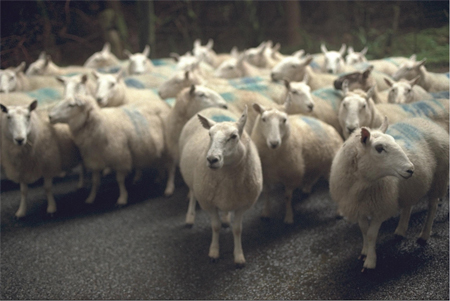
“The pages of most books were of mottled parchment, that is, dried sheepskin, which was . . . nowhere more abundant than in Ireland, whose bright green fields still host each April an explosion of new white lambs. Vellum, or calfskin, which was more uniformly white when dried, was used . . . sparingly for the most honored texts. . . . It is interesting to consider that the shape of the modern book, taller than wide, was determined by the dimensions of a sheepskin, which could most economically be cut into double pages that yield our modern book shape when folded.”
—Thomas Cahill, How the Irish Saved Civilization: The Untold Story of Ireland’s Heroic Role from the Fall of Rome to the Rise of Medieval Europe, 1995.
the Irish codex
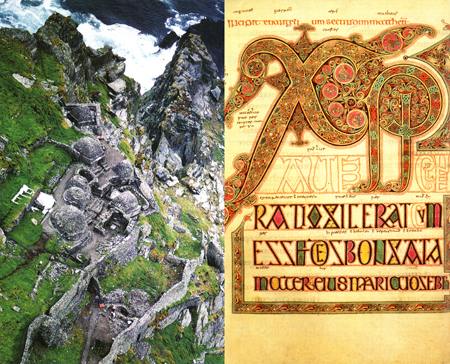
A seventh-century monastery on Skellig Michael, off the Irish coast, and a page from the Book of Kells.
“At the outset there were in Ireland no scriptoria to speak of, just individual hermits and monks, each in his little beehive cell or sitting outside in fine weather, copying a needed text from a borrowed book, old book on one knee, fresh sheepskin pages on the other. . . . [T]hey found the shapes of letters magical. Why, they asked themselves, did a B look the way it did? Could it look some other way? . . . The result of such why-is-the-sky-blue questions was a new kind of book, the Irish codex; and one after another, Ireland began to produce the most spectacular, magical books the world has ever seen.”
—Thomas Cahill, How the Irish Saved Civilization: The Untold Story of Ireland’s Heroic Role from the Fall of Rome to the Rise of Medieval Europe, 1995.