red as a pulpit cushion
“Tony Lumpkin. Ah! could you but see Bet Bouncer of these parts, you might then talk of beauty. Ecod, she has two eyes as black as sloes, and cheeks as broad and red as a pulpit cushion. She’d make two of she.”
—Oliver Goldsmith, She Stoops to Conquer, 1773.
an incessant game of tennis between the colors
“FELLINI: Making films in color is, I believe, an impossible operation. . . . In order to truly express the chromatic values of a face, a landscape, some scene or other, it is necessary to light it according to certain criteria, in function of both personal taste and technical exigencies. And all goes well so long as the camera doesn’t move. But as soon as the camera moves in on the faces or objects so lighted, the intenstiy of the light is heightened or deadened; and, depending on whether the light is heightened or deadened, all the chromatic values are intensified or deadend; the camera moves, the light changes.
There is also an infinitude of contingencies that condition the color . . . these are the innumerable and continual traps that have to be dealt with, every day, when shooting in color. For example, colors interfere, set up echoes, are conditioned by one another. Lighted, color runs over the outline that holds it, emanates a sort of luminous aureola around neighboring objects. Thus there is an incessant game of tennis between the colors. Sometimes it even happens that the result of these changes is agreeable, better than what one had imagined; but it’s always a somewhat chancy, uncontrollable result. Finally, the human eye selects and in this way already does artist’s work, because the human eye, the eye of man, sees chromatic reality through the prisms of nostaligia, of memory, of presentiment or imagination. This is not the case with the lens, and it happens that you believe you are bringing out certain values in a face, a set, a costume, while the lens brings out others. In this way, writing becomes very difficult; it is as if, while writing, a modifying word escapes your pen in capital letters or, still worse, one adjective appears instead of another, or some form of punctuation that completely changes the sense of the line. However, in spite of these pessimistic considerations, the film I am working on is in color, because it was born in color in my imagination.
KAST: I have the impression that Giulietta of the Spirits is a film in which time does not exist: the past, the present, the future and the imaginary are mixed . . .
FELLINI: Yes, that’s quite so. The color is part of the ideas, the concepts, in the same fashion as, in a dream, red or green have this or that significance. The color participates not only in the language but in the plot itself of the film This is why, in spite of deceptions or fears that attend shooting in color, I believe that color is an enrichment, with the disquieting, sinister, carnivalesque, in a certain sense lugubrious, tone that it brings with it.”
—Federico Fellini, interviewed by Pierre Kast, 1965. From Interviews with Film Directors, by Andrew Sarris, 1967.
the scene in the shack
“GODARD—The dialogue [in Red Desert] is simper, more funtional than that of your previous films; isn’t their traditional role of “commentary” taken by the color?
ANTONIONI—Yes, I believe that is true. Let us say that, here, the dialogue is reduced to an indispensable minimum and that, in this sense, it is linked to the color. For example, I would never have done the scene in the shack where they talk about drugs, aphrodisiacs, without using red. I would never have done it in black and white. The red puts the spectator in a state of mind that permits him to accept this dialogue. The color is correct for the characters (who are justified by it) and also for the spectator.”
—Michelangelo Antonioni, interviewed by Jean-Luc Godard, 1964. From Interviews with Film Directors, by Andrew Sarris, 1967.
workers’ eyes must have a rest
“You know that a psycho-physiology of color exists; studies, experiments have been done on this subject. The interior of the factory seen in the film [Red Desert] was painted red; two weeks later the workers were fighting amongst one another. It was re-painted in pale green and everyone was peaceful. The workers’ eyes must have a rest.”
—Michelangelo Antonioni, interviewed by Jean-Luc Godard, 1964. From Interviews with Film Directors, by Andrew Sarris, 1967.
a perception of something previously unknown
“The psychology of quotation in literature is analogous to that in music: ‘Even if a text is wholly quotation, the condition of quotation itself qualifies the text and makes it so far unique. Thus a quotation from Marvell by Eliot has a force slightly different from what it had when Marvell wrote it. Though the combination of words is unique it is read, if the reader know his words either by usage or dictionary, with a shock like that of recognition. The recognition is not limited, however, to what was already known in the words; there is a perception of something previously unknown, something new which is a result of the combination of the words, something which is literally an access of knowledge.’”
—Donald Jay Grout, a footnote from A History of Western Music, third edition, 1980. He is quoting R.P. Blackmur, Form and Value in Modern Poetry.
a light without shadow
“The virtue of all-in wrestling is that it is the spectacle of excess. Here we find a grandiloquence which must have been that of ancient theatres. And in fact wrestling is an open-air spectacle, for what makes the circus or the arena what they are is not the sky (a romantic value suited rather to fashionable occasions), it is the drenching and vertical quality of the flood of light. Even hidden in the most squalid Parisian halls, wrestling partakes of the nature of the great solar spectacles, Greek drama and bullfights: in both, a light without shadow generates an emotion without reserve.”
—Roland Barthes, The World of Wrestling, from Mythologies, 1957, translated from the French by Jonathan Cape, 1972.
the most demystifying of all senses
“In the exhibition halls, the car on show is explored with an intense, amorous studiousness: it is the great tactile phase of discovery, the moment when visual wonder is about to receive the reasoned assault of touch (for touch is the most demystifying of all senses, unlike sight, which is the most magical).”
—Roland Barthes, The New Citroen, from Mythologies, 1957, translated from the French by Jonathan Cape, 1972.
take a black pebble
“Or take a black pebble: I can make it signify in several ways, it is a mere signifier; but if I weigh it with a definite signified (a death sentence, for instance, in an anonymous vote), it will become a sign.”
—Roland Barthes, Myth Today, from Mythologies, 1957, translated from the French by Jonathan Cape, 1972.
Olympia
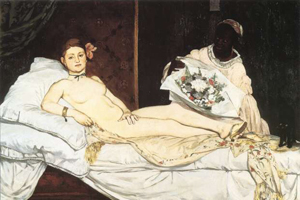
“It is not hard to see why viewers at the 1865 Salon, where Olympia was first exhibited, resisted so strenuously her thin-lipped invitation. . . .
It is as though Manet, having accepted his friend Baudelaire?s challenge to be a painter of modern, urban life in all its transitory aspects, had decided to throw the challenge right back at the onlooker. Modern life in the industrial era implied fragmentation, dislocation, uncertainty, risk, it was full of ironic and inharmonious details?like the black cat arching its back at the end of Olympia?s bed.”
—Calvin Tomkins, the essay Manet and De Kooning, February 6, 1984. From Post- to Neo-: The Art World of the 1980s, 1988.
Blue Ether
“The lovers were just entering the grounds of the pension. They were leaning toward each other as the water-oaks bent from the sea. There was not a particle of earth beneath their feet. Their heads might have been turned upside-down, so absolutely did they tread upon blue ether.”
—Kate Chopin (1851–1904), The Awakening, 1899.