The white light of the moon
“The white light of the moon had fallen upon the world like the mystery and the softness of sleep.”
—Kate Chopin (1851–1904), The Awakening, 1899.
Pirate gold
“Pirate gold isn’t a thing to be hoarded or utilized. It is something to squander and throw to the four winds, for the fun of seeing the golden specks fly.”
—Kate Chopin (1851–1904), spoken by Edna in The Awakening, 1899.
Miss Mayblunt
“‘Something new, Edna?’ exclaimed Miss Mayblunt, with lorgnette directed toward a magnificent cluster of diamonds that sparkled, that almost sputtered, in Edna’s hair, just over the center of her forehead.
‘Quite new; “brand” new, in fact; a present from my husband. It arrived this morning from New York.’”
—Kate Chopin (1851–1904), from The Awakening, 1899.
the glow
“The golden shimmer of Edna’s satin gown spread in rich folds on either side of her. There was a soft fall of lace encircling her shoulders. It was the color of her skin, without the glow, the myriad living tints that one may sometimes discover in vibrant flesh.”
—Kate Chopin (1851–1904), from The Awakening, 1899.
the million lights of the sun
“The water of the Gulf stretched out before her, gleaming with the million lights of the sun.”
—Kate Chopin (1851–1904), from The Awakening, 1899.
ardent kisses
“What embraces, in which the lilacs were crushed between them! What ardent kisses! What pink flushes of happiness mounting the cheeks of the two women.”
—Kate Chopin (1851–1904), Lilacs, from The Awakening and Selected Stories, 1984.
an object of art
“Every child in Alice’s class poured his or her whole heart into the Get Well cards, and each was an object of art. One card showed a brilliant ball of gold glitter, which represented the gasoline fire at the Gregg’s home. The gold ball was connected by a long streak of silver glitter to the tiny stick figure of a little girl. This was the artist trying to put out the fire with a stream from a garden hose. The caption said, Get Well Soon, Glenn Gregg.”
—Lewis Nordan, from Wolf Whistle, 1993.
a Negro cabin
“There was nobody in the shop for a haircut this time of night, just Rage Gage, the barber, and a few friends, blues singers.
The light from the front window was yellow, and although it broke up a corner of darkness and the rain with its small strength, it seemed to turn to water and to run and fade like cheap dye, once it left the window.
The house was not a real barber shop, not originally, though it had been fixed up nice. It was only a Negro cabin with a barber pole out in front of it.”
—Lewis Nordan, from Wolf Whistle, 1993.
Dance Studio Wulff
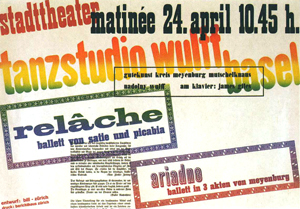
—poster design by Max Bill, 1931. Avant-Garde Graphics: 1918?1934, 2004.
a rainbow effect
“The most noticeable difference between graphics of the period between the two world wars and today is the absence of full colour in the former, although colour photography was pioneered in Russia well before the First World War. Few of the works in this book are in more than three colours; many are printed only in black and red. For a full-colour effect, designers were ingenious in overprinting two or three colours, and they exploited a traditional printing technique that spread ink of varying colours across the printing press rollers to give a rainbow effect.”
—Richard Hollis, from Art + Technology = Design, an essay in the wonderful (if you like this kind of thing) Avant-Garde Graphics: 1918?1934, 2004.