What did the zero say to the eight?
“Chalfens rarely made jokes unless they were exceptionally lame or numerical in nature or both: What did the zero say to the eight? Nice belt.”
—Zadie Smith, White Teeth, 2000.
Ems are good
“‘How are you doing on names? Any ideas?’
Alsana is decisive. ‘Meena and Malana, if they are girls. If boys, Magid and Millat. Ems are good. Ems are strong. Mahatma, Muhammad, that funny Mr Morecambe, from Morecambe and Wise—letter you can trust.’”
—Zadie Smith, White Teeth, 2000.
Hokusai
Georgia O’Keeffe
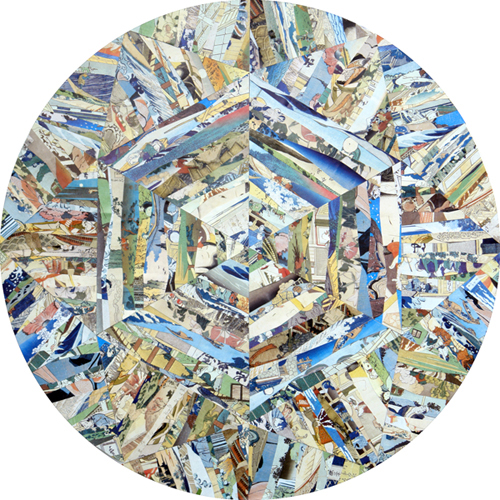
Georgia O’Keeffe, by Paul Dean. Collage, 21″x21″, 2008.
the colour of the sky
“Alsana would say, ‘Little man, how about the blue one for Amma, hmm?’,
pushing him into the primary colours section of Mothercare. ‘Just one
blue one. Go so nice with your eyes. For Amma, Magid. How can you not
care for blue? It’s the colour of the sky!’
‘No, Amma. The sky isn’t blue. There’s just white
light. White light has all of the colours of the rainbow in it, and
when it is scattered through the squillions of molecules in the sky,
the short-wave colours—blue, violet—they are the ones you see. The sky
isn’t really blue. It just looks that way. It’s called Rayleigh
scattering.’
A strange child with a cold intellect.”
—Zadie Smith, White Teeth, 2000.
white walls
“Directly in front of the Swede sat the model of the house. He could
see now what he had not been able to envision from Dawn’s
explanations—exactly how the long shed roof let the light into the main
hallway throught he high row of windows running the length of the front
wall. Yes, now he saw how the sun would arc through the southern sky
and the light would wash—and how happy it seemed to make her just to
say ‘wash’ after ‘light’—wash over the white walls, thus changing
everything for everyone.”
—Philip Roth, American Pastoral, 1997.
British tan
“‘This is Rita. We’re going to make her a dress glove, size four.
Black or brown, honey?’
‘Brown?’
From a wrapped-up bundle of hides dampening beside
Harry, he picked one out in a pale shade of brown. ‘This is a tough
color to get,’ the Swede told her. ‘British tan. You can see, there’s
all sorts of variation in the color—see how light it is there, how dark
it is down there? Okay. This is sheepskin. What you saw in my office
was pickled. This has been tanned. This is leather. But you can still
see the animal. If you were to look at the animal,’ he said, ‘here it
is—the head, the butt, the front legs, the hind legs, and here’s the
back, where the leather is harder and thicker, as it is over our own
backbones. . . .’”
—Philip Roth, American Pastoral, 1997.
Brownstone and brick
“His father used to tell him, ‘Brownstone and brick. There was the
business. Brownstone quarried right here. Know that? Out by Belleville,
north along the river. This city’s got everything. What a business that
must have been. The guy who sold Newark brownstone and brick—he was sittin’ pretty.’”
—Philip Roth, American Pastoral, 1997.
She used to collect everything
“She used to collect everything, catalog everything, explain to him
everything, examine with the pocket magnifying glass he’d given her
every chameleonlike crab spider that she brought home to hold briefly
captive in a moistened mason jar, feeding it on dead houseflies until
she released it back onto the golden rod or the Queen Anne’s lace
(‘Watch what happens now, Dad’) Where it resumed adjusting its color to
ambish its prey.”
—Philip Roth, American Pastoral, 1997.
Vernacular Baton Rouge: Doc’s WASH & DRY