a culture of spectacle
“Ordinary Romans recognized, and usually respected, the distinctive dress of the elite. . . .
At the very top of the cursus honorum, the censors wore all-purple togas to mark them out from the curule magistrates who wore the toga praetexta, while military commanders who qualified for a triumph, the Roman state’s highest award, were granted the most striking form of public dress available: the vestis triumphalis, which comprised the tunica palmata (a purple tunic with gold palm branches embroidered into it) covered by a toga picta (a purple toga emblazones with gold stars). Public dress thus contributed significantly towards dividing the Roman citizen body into its various status hierarchies. Rome was a culture of spectacle, and the spectacle of dress helped to emphasize some of its most important values.”
—Jonathan Edmondson, ‘Public Dress and Social Control in Rome’, from Roman Dress and the Fabrics of Roman Culture, edited by Jonathan Edmondson and Allison Keith, 2008.
Roman purple
“In the Roman world, purple was a colour rich in splendour and symbolic value. The elder Pliny remarked on its ability to make every garment radiant and noted its particular association with the maiestas (majesty) of childhood. Though the romans called the colour purpura and used the term as a metonym for the child’s praetexta, the shade that adorned the toga more closely resembled garnet than purple. Roman purple varied in intensity, encompassing rose and scarlet shades, but in Pliny’s estimation, in its highest glory, it was the colour of congealed blood: ‘blackish at first glance gut gleaming when held up to the light.’ Blood represents and sustains life, and is a powerful, vital force. In many cultures shades of red are believed to protect babies, children, and pregnant women—in essence, to protect nascent life.”
—Fanny Dolansky, ‘Coming of Age in the Roman World’, from Roman Dress and the Fabrics of Roman Culture, edited by Jonathan Edmondson and Allison Keith, 2008.
the toga praetexta
“[A] few authors tell us that the girl wore the toga praetexta, the toga bordered by a purple stripe, just as freeborn boys did. Why children wore the toga itself is unclear, but the wool of the garment and especially its purple band (likely woven directly onto the toga) had a general apotropaic significance. Persius described the purple stripe as the guard of pre-adolescence; . . . in a declamation attributed to the rhetorician Quintilian, the colour purple is described as the one ‘by which we make the weakness of boyhood sacred and revered’. . . .”
—Kelly Olson, ‘The Appearance of the Young Roman Girl’, from Roman Dress and the Fabrics of Roman Culture, edited by Jonathan Edmondson and Allison Keith, 2008.
Hobohemia
“Hobohemia was a complex and highly politicized social institution with its own unwritten system of laws, etiquette, mores, and division of labor. Although ‘tramp’ and ‘bum’ were sanctioned synonyms, ‘hobo’ specifically designated a wandering laborer (the word probably derives from ‘hoe boy,’ a seasoned farm worker).”
—Robbert Polito, Savage Art, A Biography of Jim Thompson, 1995.
Wieland (1798)
“American fiction begins with Charles Brockden Brown’s Wieland (1798), a sort of early-American Pop. 1280. Theodore Wieland hears a voice—he is convinced it is the voice of God—commanding him to ‘render’ his family ‘in proof of thy faith.’ He kills his wife and children, and then advances on his sister Clara. ‘This minister is evil, but he from whom his commission was received is God. Submit then with all thy wonted resignation to a decree that cannot be reversed or resisted. . . .’ Did the voice come from Carwin, the diabolical ‘biloquist’ (ventriloquist), or did it arise from Wieland’s own troubled imagination? The same questions of madness or calculation, God or the Devil [that arise in Jim Thompson’s Pop. 1280] agitate Wieland.”
—Robbert Polito, Savage Art, A Biography of Jim Thompson, 1995.
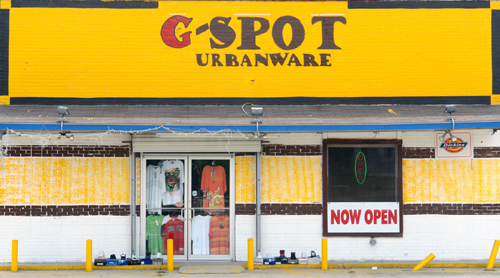
Vernacular Baton Rouge: G-SPOT URBANWARE
I’ll tell you everything
“In a lot of books I read, the writer seems to go haywire every time he reaches a high point. He’ll start leaving out punctuation and running his words together and babble about stars flashing and sinking into a deep dreamless sea. And you can’t figure out whether the hero’s laying his girl or a cornerstone. I guess that kind of crap is supposed to be pretty deep stuff—a lot of the book reviewers eat it up, I notice. But the way I see it is, the writer is just too goddam lazy to do his job. And I’m not lazy, whatever else I am. I’ll tell you everything.”
—Jim Thompson, The Killer Inside Me, 1952.
the alabaster sand
“Under the hooves of the horses the alabaster sand shaped itself in whorls strangely symmetric like iron filings in a field and these shapes flared and drew back again, resonating upon that harmonic ground and then turning to swirl away over the playa. As if the very sediment of things contained yet some residue of sentience. As if in the transit of those riders were a thing so profoundly terrible as to register even to the uttermost granulation of reality.”
—Cormac McCarthy, Blood Meridian, 1985.
there is only one plot
“There are thirty-two ways to write a story, and I’ve used them all, but there is only one plot—things are not as they seem.”
—Jim Thompson, quoted in Savage Art, A Biography of Jim Thompson by Robbert Polito, 1995.
through sunlight and through shade
“The following evening as they rode up onto the western rim they lost one of the mules. It went skittering off down the canyon wall with the contents of the panniers exploding soundlessly in the hot dry air and it fell through sunlight and through shade, turning in the lonely void until it fell from sight into a sink of cold blue space that absolved it forever of memory in the mind of any living thing that was.”
—Cormac McCarthy, Blood Meridian, 1985.