Patterns
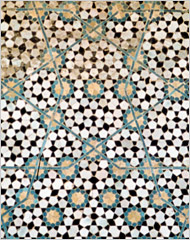 “I was 3 or 4 years old. I was playing in the garden when a brilliant,
shimmering light appeared to my left — dazzlingly bright, almost as
bright as the sun. It expanded, becoming an enormous shimmering
semicircle stretching from the ground to the sky, with sharp zigzagging
borders and brilliant blue and orange colors. Then, behind the
brightness, came a blindness, an emptiness in my field of vision, and
soon I could see almost nothing on my left side. I was terrified — what
was happening? My sight returned to normal in a few minutes, but these
were the longest minutes I had ever experienced.”
—Oliver Sacks, from Patterns, a look at visual migraines published just today at the New York Times. Oliver Sacks is brilliant, of course, and the article is well worth your time. If you’re into these things.
The War On The War On
“In the latter half of the 20th century, Americans were called to meet
abstractions with metaphors in a series of gaudy figurations popularly
called ‘The War On . . .’” So begins The War On The War On.
Iune Wind
Poppin’
the bark of the root of mandrake
“By and by Dr. Claypool laid down his pen and read the result of his labors aloud, carefully and deliberately, for this battery must be constructed on the premises by the family, and mistakes could occur; for he wrote a doctor’s hand—the hand which from the beginning of time has been so disastrous to the apothecary and so profitable to the undertaker:
‘Take of afarabocca, henbane, corpobalsamum, each two drams and a half: of cloves, opium, myrrh, cyperus, each two drams; of opobalsamum, Indian leaf, cinnamon, zedoary, ginger, coftus, coral, cassia, euphorbium, gum tragacanth, frankincense, styrax calamita, celtic, nard, spignel, hartwort, mustard, saxifrage, dill, anise, each one dram; of xylaloes, rheum ponticum, alipta, moschata, castor, spikenard, galangals, opoponax, anacardium, mastich, brimstone, peony, eringo, pulp of dates, red and white hermodactyls, roses, thyme, acorns, pennyroyal, gentian, the bark of the root of mandrake, germander, valerian, bishop’s weed, bay-berries, long and white pepper, xylobalsamum, carnabadium, macedonian, parsley-seeds, lovage, the seeds of rue, and sinon, of each a dram and half; of pure gold, pure silver, pearls not perforated, the blatta byzantina, the bone of the stag’s heart, of each the quantity of fourteen grains of wheat; of sapphire, emerald and jaspers stones, each one dram; of hazel-nut, two drams; of pellitory of Spain, shaving of ivory, calamus odoratus, each the quantity of twenty-nine grains of wheat; of honey or sugar a sufficient quantity. Boil down and skim off.’”
—Mark Twain, Those Extraordinary Twins, 1894.
Surf Icing
shrieking and blaspheming colors
“The twins were wet and tired, and they proceeded to undress without
any preliminary remarks. The abundance of sleeve made the
partnership-coat hard to get off, for it was like skinning a tarantula;
but it came at last, after much tugging and perspiring. The mutual vest
followed. Then the brothers stood up before the glass, and each took
off his own cravat and collar. . . . Each cravat, as to color, was in
perfect taste, so far as its owner’s complexion was concerned—a
delicate pink, in the case of the blonde brother, a violent scarlet in
the case of the brunette—but as a combination they broke all the laws
of taste known to civilization. Nothing more fiendish and
irreconcilable than those shrieking and blaspheming colors could have
been contrived.”
—Mark Twain, Those Extraordinary Twins, 1894.
an abecedary
scientific fatalism
“First, I found the whole modern world talking scientific fatalism; saying that everything is as it must always have been, being unfolded without fault from the beginning. The leaf on the tree is green because it could never have been anything else. Now, the fairy-tale philosopher is glad that the leaf is green precisely because it might have been scarlet. He feels as if it had turned green an instant before he looked at it. He is pleased that snow is white on the strictly reasonable ground that it might have been black. Every colour has in it a bold quality as of choice; the red of garden roses is not only decisive but dramatic, like suddenly spilt blood. He feels that something has been done. But the great determinists of the nineteenth century were strongly against this native feeling that something had happened an instant before. In fact, according to them, nothing ever really had happened since the beginning of the world. Nothing ever had happened since existence had happened; and even about the date of that they were not very sure.”
—G.K. Chesterton, Orthodoxy, 1908.
a single jewel
“For the universe is a single jewel, and while it is a natural cant to talk of a jewel as peerless and priceless, of this jewel it is literally true. This cosmos is indeed without peer and without price: for there cannot be another one.”
—G.K. Chesterton, Orthodoxy, 1908.