a flower among stones
“The ancient Romans prized the ruby above the diamond, calling this gem ‘a flower among stones.’ For the Greeks it was the ‘mother of all gems.’ And back in 1560 Benvenuto Cellini declared that the price of ruby was eight times that of diamond. Of course, that was before the brilliant cut was developed for the diamond, which significantly enhanced its looks.
The ruby has always been, and remains today, the world’s most precious gemstone. . . . A flawless ruby, for instance, is worth more than a flawless diamond of equal weight.”
—Diane Morgan, Fire and Blood; Rubies in Myth, Magic, and History, 2008.
Burmese rubies
“[F]luorescence is triggered by ultraviolet light. . . . Burmese rubies fluoresce strongly to long wave . . . ultraviolet radiation and less strongly to shortwave radiation. . . .
Rubies’ fluorescence is apparent in both artificial light and in some cases even in daylight, making the gem appear truly radiant. The fact that many Burmese rubies actually fluoresce to visible light is rather unusual. . . . The ancient Burmese considered this feature supernatural—and in some cases a product of witchcraft. . . .
At one time it was believed that by looking into the strange, fiery fluorescence of Burmese rubies, one could see dragons and other mystical beasts.”
—Diane Morgan, Fire and Blood; Rubies in Myth, Magic, and History, 2008.
The ruby laser
“Rubies have their practical, as well as their beautiful aspects. . . . Primary among these is the use of the ruby for lasers, although I should say that natural rubies are of no use here—the key element chromium must be ‘doped up’ in synthetic rubies to create the laser. . . .
The ruby laser was the first laser invented in 1960. . . . The key is chromium, that magic element that makes rubies red. Chromium atoms absorb green and blue light and emit or reflect only red light. Chromium is responsible for the ‘lasing’ behavior of the crystal.”
—Diane Morgan, Fire and Blood; Rubies in Myth, Magic, and History, 2008.
the pallor of sand
“The desert. No seasons of bloom and decay. Just the endless turn of night and day. Out of time: and she is gazing—not over it, taken in to it, for it has no measure of space, features that mark distance from here to there. In a film of haze there is no horizon, the pallor of sand, pink-traced, lilac-luminous with its own colour of faint light, has no demarcation from land to air. Sky-haze is indistinguishable from sand-haze. All drifts together, and there is no onlooker; the desert is eternity.”
—Nadine Gordimer, The Pickup, 2001.
a world of bioluminescence
I read a book on bioluminescence a few years ago (it’s in the archives, somewhere) and I remember that the author felt that the original researchers in the area, biology I assume, were thought by many of their colleagues to be a little bit ‘silly’ and not as ‘serious’ as other researchers, the importance of color once again casually dismissed by the ‘rational’ mind.
But when bioluminescent creatures of green, blue and eventually red were discovered by independent researchers around the world, above and below sea level, there was great excitement. Red, green and blue are, of course, the additive primaries of light, the colors that are projected from your computer screen and combined by your eyes and mind to form the illusion of a full range of colors.
Forget HD DVD and yer Blu-ray, after watching this presentation and considering the gene-splicers who must be working on this, I can’t help but think . . . I want bioluminescent streaming color video pets!
Sleeve Heads
 Vinyl Sleeve Heads, from Yadogg.
the multipliable work ad lib
“Black and white—dot and stroke—to print, to transpose, to transmit, to distribute in images, by the press, by the technique of projections. It is the multipliable work ad lib, which can be recreated at a distance by another.”
—Victor Vasarely, 1957; quoted in Vasarely, by Marcel Joray, 1976.
Carried by the waves
“Carried by the waves, I flee forward, now toward the atom, now toward the galaxies.”
—Victor Vasarely; quoted in Vasarely, by Marcel Joray, 1976.
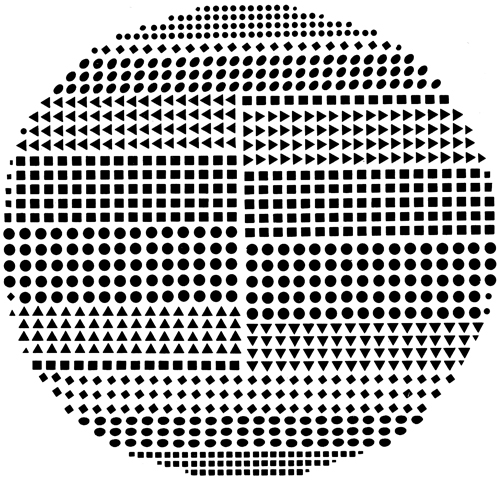
Plastic constituents of particle character, 1958
the letter ‘K’
“Although at the time of his death Kafka was unknown outside of Prague,
over the years his works and fame have spread far and wide. His
influence on modern literature is so pervasive that it is nearly
impossible to trace – Kafka has become part of the very texture of
modern writing, and he practically owns the letter ‘K.’”
—Jeff Nowak & Allen B. Ruch, from The most fortunate and unfortunate of men, an online biography of Franz Kafka, 2004.