purest indigo
“On the day that followed they crossed a lake of gypsum so fine the ponies left no track upon it. The riders wore masks of boneblack smeared about their eyes and some had blacked the eyes of their horses. The sun reflected off the pan burned the undersides of their faces and shadow of horse and rider alike were painted upon the fine white powder in purest indigo.”
—Cormac McCarthy, Blood Meridian, 1985.
Vernacular Baton Rouge: Antiques
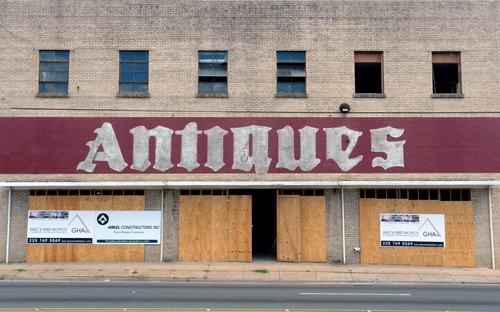 501 Government Street.
strands of the night
“They rode on and the sun in the east flushed pale streaks of light and then a deeper run of color like blood seeping up in sudden reaches flaring planewise and where the earth drained up into the sky at the edge of creation the top of the sun rose out of nothing like the head of a great red phallus until it cleared the unseen rim and sat squat and pulsing and malevolent behind them. The shadows of the smallest stones lay like pencil lines across the sand and the shapes of the men and their mounts advanced elongate before them like strands of the night from which they’d ridden, like tentacles to bind them to the darkness yet to come.”
—Cormac McCarthy, Blood Meridian, 1985.
white noon
“In two days they began to come upon bones and cast-off apparel. They saw halfburied skeletons of mules with the bones so white and polished they seemed incandescent even in that blazing heat and they saw panniers and packsaddles and the bones of men and they saw a mule entire, the dried and blackened carcass hard as iron. They rode on. The white noon saw them through the waste like a ghost army, so pale they were with dust, like shades of figures erased upon a board.”
—Cormac McCarthy, Blood Meridian, 1985.
the ‘Sorryno’ Irani restaurant
“Lambajan said nothing, and his silence spread outwards from him, muffling the hooting of taxis, the cigarette-vendor’s cries, the shrieks of street-urchins as they played fighting-kite and hoop and dodge-the-traffic, and the loud playback music emerging from the ‘Sorryno’ Irani restaurant up the hill (so called because of the huge blackboard at the entrance reading Sorry, No Liquor, No Answer Given Regarding Addresses in Locality, No Combing of Hair, No Beef, No Haggle, No Water Unless Food Taken, No News or Movie magazine, no Sharing of Liquid Sustenances, No Taking Smoke, No Match, No Feletone Calls, No Incoming with Own Comestible, No Speaking of Horses, No Sigret, No Taking of Long Time on Premises, No Raising of Voice, No Change, and a crucial last pair, No Turning Down of Volume—It Is How We Like, and No Musical Request—All Melodies Selected Are To Taste of Prop).”
—Salman Rushdie, The Moor’s Last Sigh, 1995.
a shadow
“‘Adios,’ she added in Spanish, ‘I have no house only a shadow. But whenever you are in need of a shadow, my shadow is yours.’
‘Thank you.’
‘Sank you.’
‘Not sank you, Señora Gregorio, thank you.’
‘Sank you.’”
—Malcolm Lowry, Under the Volcano, 1947.
Drank
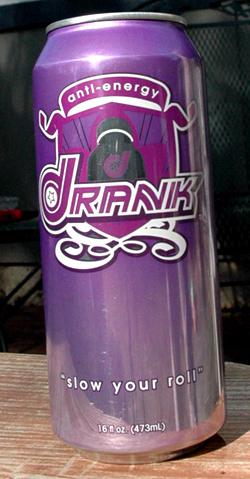
Now, let’s look at the package. The color palette is great: brooding violet and magenta bring us into the hooded figure in black. The white contrasts well with the darker background, but the outer border may be a little too bold, and I think the logo itself is . . . clunky. Oh, and I don’t like the letterspacing of “slow your roll”, although . . . I get it. (We’re supposed to read it s l o w l y. I get it, I get it!)
I definitely do like the bright Coca-Cola filigree below the shield. I can’t help but think that this is a sly jab the man of soft drink men, the Coca-Cola man, who jealously guards his patented “dynamic ribbon device” from an office that towers high above Atlanta. Will he stoop to a lawsuit against this fool?
sunlight, sunlight, sunlight
“Ah none but he knew how beautiful it all was, the sunlight, sunlight, sunlight flooding the bar of El Puerto del Sol, flooding the watercress and oranges, or falling in a single golden line as if in the act of conceiving a God, falling like a lance straight into a block of ice—”
—Malcolm Lowry, Under the Volcano, 1947.
nights the color of grey hair
“Night: and once again, the nightly grapple with death, the room shaking with daemonic orchestras, the snatches of fearful sleep, the voices outside the window, my name being continually repeated with scorn by imaginary parties arriving, the dark spinets. As if there were not enough real noises in these nights the color of grey hair.”
—Malcolm Lowry, Under the Volcano, 1947.
the forty shades of green
“At the end of her period of house arrest . . . Aurora invited Camoens inside, making him the second person on earth to see her work. Every inch of the walls and even the ceiling of the room pullulated with figures, human and animal, real and imaginary, drawn in a sweeping black line that transformed itself constantly, that filled here and there into huge blocks of colour, the red of the earth, the purple and vermilion of the sky, the forty shades of green; a line so muscular and free, so teeming, so violent, that Camoens with a proud father’s bursting heart found himself saying, ‘But it is the great swarm of being itself.’”
—Salman Rushdie, The Moor’s Last Sigh, 1995.